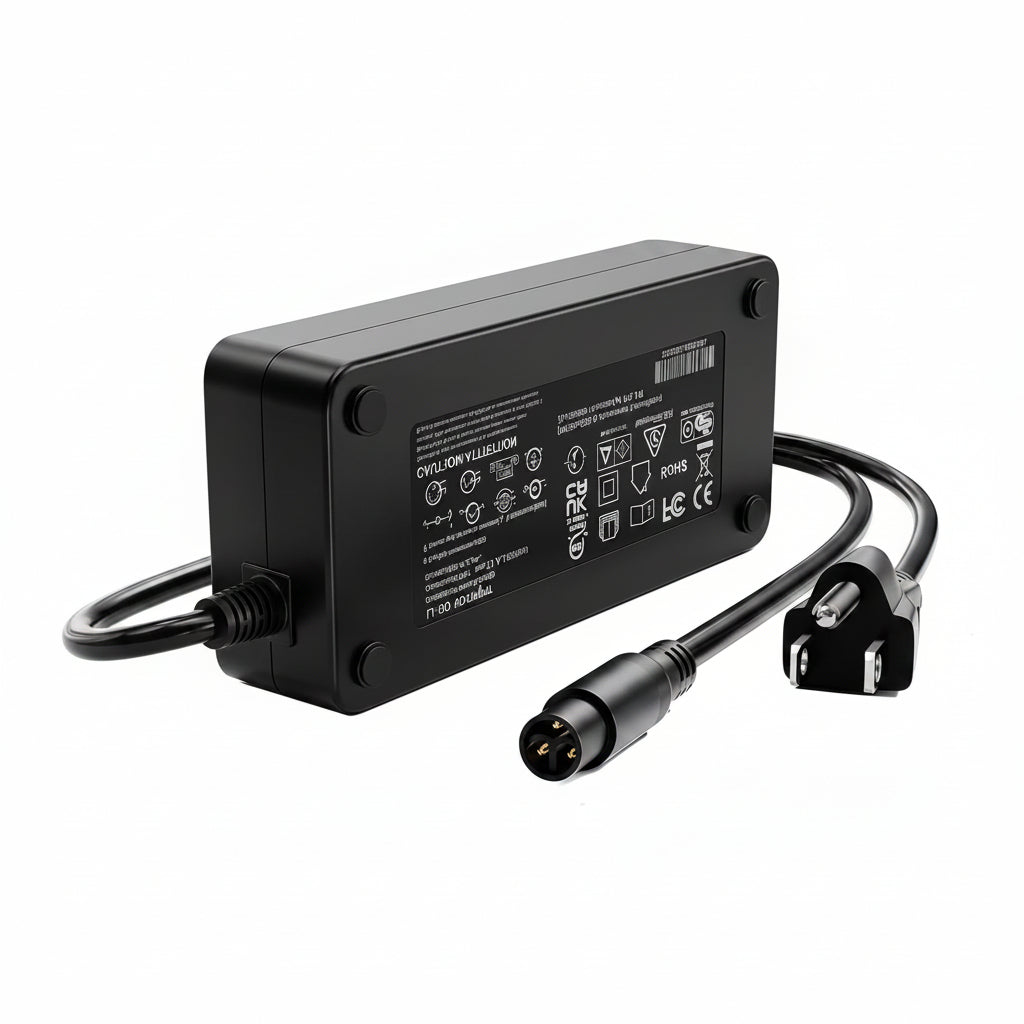
A Super73 replacement charger should not be selected by brand name alone. You need to match the battery system, the original charger's DC output, the approved charging current, the connector and its polarity. Model families and production revisions can differ, so the label on your own equipment is the best starting point.
This guide explains how to evaluate a 54.6V replacement charger for a compatible 48V lithium-ion Super73 e-bike and when to stop and ask the manufacturer for confirmation.

Quick answer: the five checks
- Battery chemistry: confirm lithium-ion, not lead-acid or another chemistry.
- Nominal battery voltage: confirm the installed battery is a compatible 48V system.
- Charger output: compare the original charger's OUTPUT line; many 48V lithium-ion systems use 54.6V at full charge.
- Charging current: use only an amperage approved for the battery, BMS, port and wiring.
- Connector and polarity: match shape, pin count, dimensions, gender, pin assignment and polarity exactly.
Why a 48V lithium-ion battery often uses a 54.6V charger
鈥?8V鈥?is normally the battery's nominal system voltage, not its full-charge voltage. A conventional 13-series lithium-ion pack reaches about 54.6V when each series group is charged to 4.2V:
This explains why many 48V lithium-ion e-bikes specify a charger marked 54.6V DC output. It does not prove compatibility by itself. A different chemistry or battery design can require a different charging profile, and the original charger label or manufacturer documentation takes priority.
Read the label correctly: INPUT versus OUTPUT
Replacement-charger mistakes often happen because two different sections of the label are confused:
- INPUT tells you what wall power the charger accepts, such as an AC voltage and frequency range.
- OUTPUT tells you the DC voltage and current delivered to the e-bike battery.
For battery compatibility, compare OUTPUT voltage and current. A wide AC input range does not make the charger universal for different battery voltages.

2A, 3A or 5A: faster is not automatically compatible
The BICMDO listing offers separate 2A, 3A and 5A variants. Charging current affects ideal charging time, but the highest option is not automatically the best choice. The battery-management system, cells, charge port and wiring must all support the selected current.
If the original charger is rated 2A, replacing it with a correctly matched 2A charger is the conservative route. Do not move to 3A or 5A merely to charge faster unless the e-bike or battery manufacturer explicitly permits it.
A rough planning calculation is:
Real charging time is normally longer than that simple result because the battery may not start empty, charging slows near full, and BMS behaviour varies. Never treat the calculation as a guaranteed charge time.
Connector shape is only half the connector check
Two connectors can look alike and even fit physically while using different pin assignments or polarity. Before ordering, compare:
- connector family and pin count;
- outer dimensions and pin diameter;
- plug versus socket gender;
- keying and alignment notch;
- positive and negative pin assignment;
- any communication or sense pin used by the battery system.
Use a manufacturer diagram or an exact documented match. Do not infer electrical wiring from cable colour or a marketplace photograph, and never force a plug into the charge port.
Which Super73 models are compatible?
The current BICMDO product listing is marketed for compatible Super73 Z, S and R series e-bikes and explicitly excludes Z1 and S1. That is useful screening information, but it is not a substitute for checking the bike in front of you. Battery replacements, production changes and regional versions can alter the required charger.
Before purchase, photograph these items clearly:
- the full original charger label;
- the battery label;
- the charging port straight on;
- the old connector from the side and pin end;
- the bike model and serial information.
If the labels are missing or illegible, contact Super73 or the battery supplier with the serial information rather than guessing.
Replacement charger decision table
| What you find | Decision |
|---|---|
| Original OUTPUT is 54.6V and current, connector and polarity all match | Potential match; complete the safety and model checks |
| Original current is 2A but replacement selected is 5A | Do not use unless the manufacturer approves 5A charging |
| Plug fits but polarity is unknown | Do not connect |
| Battery label does not identify 48V lithium-ion | Stop and confirm chemistry and charging specification |
| Port or battery is burned, swollen, cracked or wet | Do not charge; seek qualified inspection |
How to connect a confirmed replacement safely
Follow the e-bike and charger manuals because connection order can vary. In general:
- Park the bike in a dry, ventilated area on a stable surface.
- Switch the bike off and inspect the battery, port, charger and cables.
- Make sure the battery is within its permitted charging temperature.
- Align the connector without twisting or forcing it.
- Connect in the sequence specified by the manufacturer.
- Keep the charger uncovered on a hard, nonflammable surface.
- Monitor the first charge and stop if there is unusual heat, smell, noise, smoke or repeated fault indication.
- Disconnect according to the manual and refit any port cover.
Do not charge near an exit, on a bed or sofa, under clothing, in rain, or with an extension arrangement not rated for the load. Do not use a charger with damaged insulation, bent pins or a loose connector.

When a charger fault may actually be a battery or port fault
A bike that will not charge does not automatically need a new charger. Possible causes include a deeply discharged or faulted battery, blown protection device, damaged charge port, loose internal wiring, temperature protection, or battery-management-system lockout.
Stop troubleshooting and seek qualified service if you see swelling, leaking, cracking, melted plastic, corrosion, water intrusion, impact damage, repeated arcing or unusual heat. Do not open a lithium-ion battery pack or charger enclosure.
For broader diagnosis, read how to tell if an e-bike charger is bad.
Buying checklist
- Exact e-bike model, region and production version confirmed
- Battery marked as a compatible 48V lithium-ion system
- Original charger OUTPUT verified as 54.6V DC
- Approved current confirmed: 2A, 3A or 5A as applicable
- Connector family, dimensions, gender and keying matched
- Polarity and pin assignment documented
- Battery and charging port free from damage
- Return and warranty terms reviewed before purchase
Final recommendation
Start with the original charger and battery labels, not the bike name. If 54.6V output, approved current, connector and polarity all match, review the BICMDO 54.6V 2A/3A/5A charger for compatible Super73 48V e-bikes. If any specification remains uncertain, ask the e-bike or battery manufacturer to confirm it before connecting a replacement.
Need a different voltage or connector? Browse the 60V electric scooter charger guide and apply the same five checks to every candidate.
Share:
60V Electric Scooter Charger Guide: Why 67.2V, 3A and GX16-3 Must Match
How to Match an E-Bike Charger: Voltage, Amps, Plug Type and Polarity Explained