An e-bike charger is not compatible just because its plug fits. The output voltage, battery chemistry, charging current, connector dimensions, pin assignment and polarity must all match the battery system. Getting one of those details wrong can prevent charging, damage the port or charger, or create a serious battery hazard.
This guide shows you how to match an e-bike charger methodically. Use the original charger label, battery label and manufacturer documentation as your primary evidence; model names and marketplace titles are only starting points.

The five checks that must all pass
| Check | What must match | Best evidence |
|---|---|---|
| Battery chemistry | Lithium-ion, LiFePO4, lead-acid or another specified chemistry | Battery and original charger labels |
| Output voltage | The battery’s required full-charge voltage | Original charger OUTPUT line |
| Output current | A rate approved for the battery, BMS, port and wiring | Manufacturer specification |
| Connector | Family, diameter, pin count, gender and keying | Exact measurements and connector diagram |
| Pinout/polarity | Positive, negative and any signal pin in the correct location | Manufacturer wiring documentation |
Nominal battery voltage is not charger output voltage
The number used to describe an e-bike battery—36V, 48V, 52V or 60V—is usually its nominal system voltage. The charger must reach the pack’s specified full-charge voltage, which is higher. For a common lithium-ion pack using cells charged to 4.2V, the series count explains the relationship:
| Common nominal system | Typical series count | Common full-charge voltage |
|---|---|---|
| 36V lithium-ion | 10S | 42.0V |
| 48V lithium-ion | 13S | 54.6V |
| 52V lithium-ion | 14S | 58.8V |
| 60V lithium-ion | 16S | 67.2V |
These are common examples, not permission to infer a charger from nominal voltage alone. LiFePO4 and other chemistries use different cell voltages and charging profiles. Some manufacturers also use nonstandard naming. Copy the exact DC output specification from the approved original charger or battery documentation.
Read INPUT and OUTPUT separately
INPUT describes wall power accepted by the charger, such as 100–240V AC. OUTPUT describes the DC power delivered to the battery, such as 54.6V DC, 2A. A wide input range means the charger may accept different mains voltages; it does not make the output compatible with different e-bike batteries.
How to choose charger amps
Amperage controls charging rate. A 3A charger can theoretically replace energy faster than a 2A charger, but the battery-management system, cells, charge port and wiring must support that current. “Faster” is not automatically safer or compatible.
- If the original charger is 2A, another approved 2A unit is generally the conservative replacement.
- Do not upgrade from 2A to 3A or 5A unless the battery or bike manufacturer explicitly allows it.
- A lower current may charge more slowly, but it still needs manufacturer approval and the same voltage, profile, plug and pinout.
- Current capability on the charger label is not a setting the battery must consume continuously; the charging system regulates the process. Compatibility is still required.
A rough ideal-time estimate is battery capacity in amp-hours divided by charger amps. A 15Ah pack at 3A gives five hours in a simplified calculation. Actual charging normally takes longer because the pack may not start empty, losses occur and current tapers near full. Do not advertise or plan around that quotient as a guaranteed time.

Plug type is more than shape
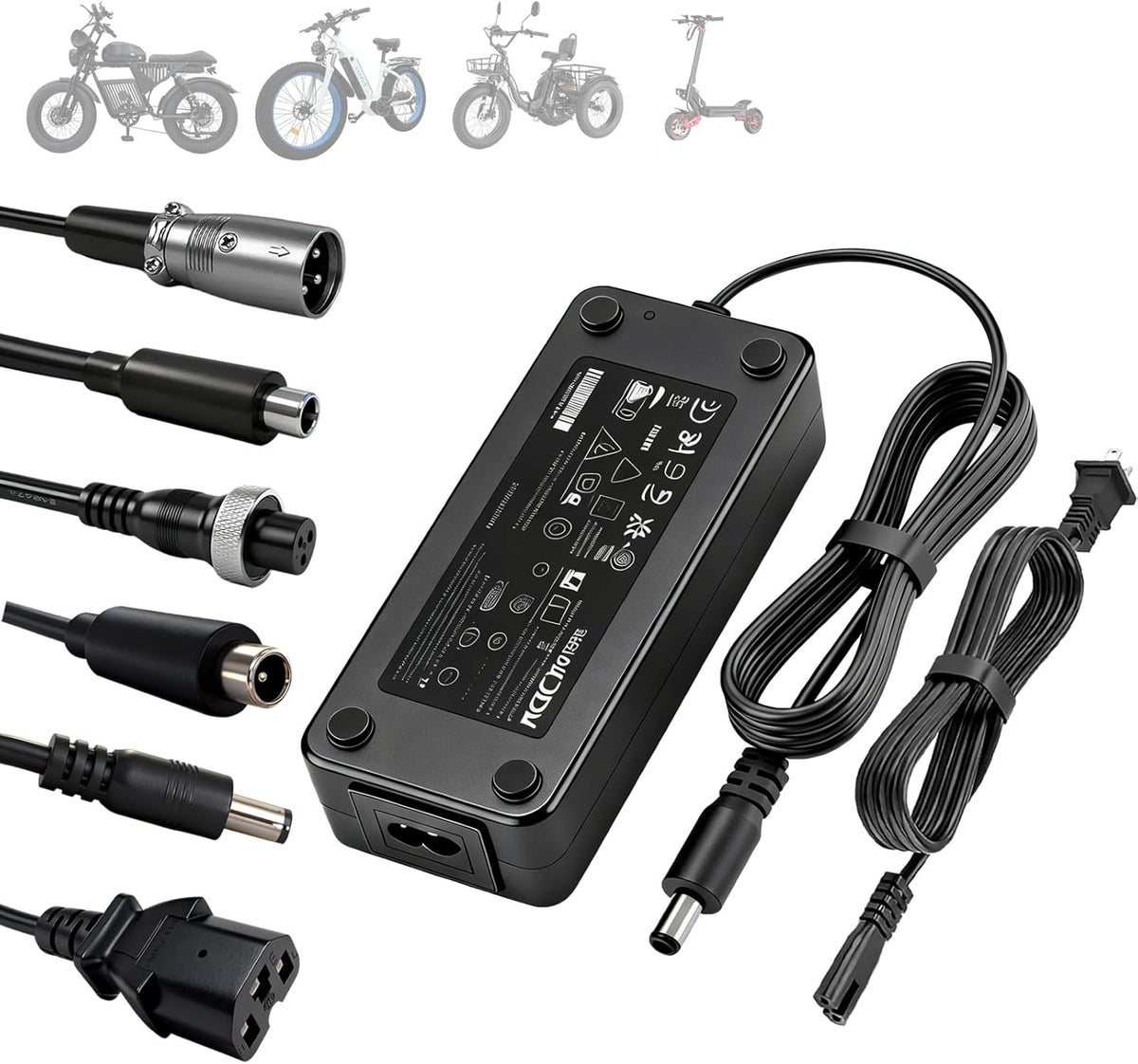
“Three-pin,” “barrel plug” or “aviation connector” is not precise enough. Similar-looking connectors can use different diameters, genders, keying and wiring. Record all of the following:
- connector family, such as XLR, GX-series aviation or DC barrel;
- number of pins or barrel inner and outer diameter;
- plug/socket gender on the charger side;
- alignment notch, thread or locking method;
- pin assignment for positive, negative and any sense/communication connection;
- polarity symbol printed on the label, where provided.
Do not assume the center pin is positive. Do not assume that two three-pin connectors share the same pinout. Cable colors are not reliable evidence, and forcing a nearly matching plug can deform the charging port.
Can you check polarity with a multimeter?
A trained person can measure charger output polarity with an appropriate meter and safe technique, but exposed pins can short and some chargers behave differently without a load. Manufacturer documentation is preferable. If you are not confident identifying the connector and safely using test equipment, ask the bike, battery or charger supplier to confirm the pinout.
A step-by-step charger matching workflow
- Switch off and inspect. Do not charge a swollen, cracked, wet, corroded, impact-damaged or unusually hot battery.
- Photograph the labels. Capture the complete original charger OUTPUT line, battery voltage/chemistry, bike model and serial information.
- Confirm chemistry and voltage. Match the approved charging profile and exact output voltage.
- Confirm current. Choose only a charging current permitted for that battery and charge port.
- Identify the connector. Compare the pin end, side view, dimensions, keying and gender.
- Verify pinout and polarity. Obtain an explicit diagram or confirmation; “the plug fits” is not evidence.
- Check mains compatibility. Confirm the charger’s AC input range and the correct wall plug for your location.
- Review the manual. Follow the specified connection order, temperature range and indicator meanings.
- Monitor the first charge. Charge in a dry, ventilated area on a hard surface and stop for unusual heat, smell, sound, smoke or repeated faults.
Keep the charger uncovered and away from bedding, exits, flammable materials, rain and standing water. Never open a charger or lithium battery enclosure to improvise a repair.
Examples from current charger listings
48V lithium-ion systems requiring 54.6V
The BICMDO 54.6V 3A charger with interchangeable connectors is designed for compatible 48V lithium-ion systems. Its connector selection does not make it universal across voltages, chemistries or pinouts. Confirm that the battery supports 3A charging and that the selected tip is wired correctly.
36V Bosch-compatible systems requiring 42V
The BICMDO 42V 2A charger for compatible Bosch 36V e-bike systems uses a specific oval connector. It should only be considered after comparing the battery generation, approved output and connector with the bike in front of you.
48V systems with a model-specific connector
The BICMDO 54.6V 2A/3A charger for compatible Ridstar Q20-series systems illustrates why model and connector checks work together. Production revisions or replacement batteries may differ, so compare labels and the actual port before ordering.

When the charger may not be the problem
A battery that will not charge can have a damaged port, loose wiring, blown protective component, temperature lockout, deeply discharged cells or BMS fault. A charger LED that stays green can mean “standby” rather than “battery full.” If a known-correct charger will not start, do not repeatedly reconnect it or bypass protection.
Seek qualified service for swelling, leakage, burnt pins, melting, arcing, water intrusion, crash damage or abnormal heat. Read our guide to matching a 60V scooter charger for a worked 67.2V example.
Printable buying checklist
- Battery chemistry confirmed
- Nominal system voltage recorded
- Required charger OUTPUT voltage copied exactly
- Approved output current confirmed
- Connector family and dimensions matched
- Gender and keying matched
- Pinout and polarity documented
- AC input and wall plug suitable for the location
- Battery, port and cable free from damage
- Warranty, returns and product instructions reviewed
Frequently asked questions
Can I use a charger with the same voltage but more amps?
Only if the battery or bike manufacturer approves that charging current. The BMS, cells, port and wiring all need to support it. Do not assume a higher-current charger is safe because voltage matches.
Can I use a 42V charger on a 48V battery?
No. A common 42V lithium-ion charger is associated with a 36V nominal pack, while many 48V lithium-ion packs require 54.6V. Use the exact approved output for your battery chemistry and configuration.
If the plug fits, can I try it?
No. The voltage, pinout or polarity may be wrong. Verify all specifications before making a connection.
Are connector adapters safe?
An adapter is acceptable only when its voltage/current rating, wiring, insulation, pinout and polarity are documented for the complete system. An adapter cannot correct an incompatible charging voltage or profile.
Does a 100–240V input mean the charger works with every battery?
No. It only describes the accepted wall-power range. Battery compatibility depends primarily on the DC output, chemistry, current, connector and pinout.
What should I send customer support?
Send clear photos of the original charger label, battery label, charging port, old connector from two angles, and bike model/serial information. State your country and whether the battery is original or replaced.
Final recommendation
Match in this order: chemistry, output voltage, approved current, connector, pinout and polarity. Treat the e-bike name as supporting information—not the final compatibility test. When every item is documented, review the relevant BICMDO product page for current specifications and availability. When one item remains uncertain, pause and request confirmation before buying or connecting the charger.
This article provides general selection and safety information. The battery, bike and charger manufacturers’ latest instructions take priority.
Share:
Super73 Replacement Charger Guide: Match 54.6V, Amps and Connector
52V E-Bike Charger Guide: How to Match 58.8V, Amps, Connector and Polarity