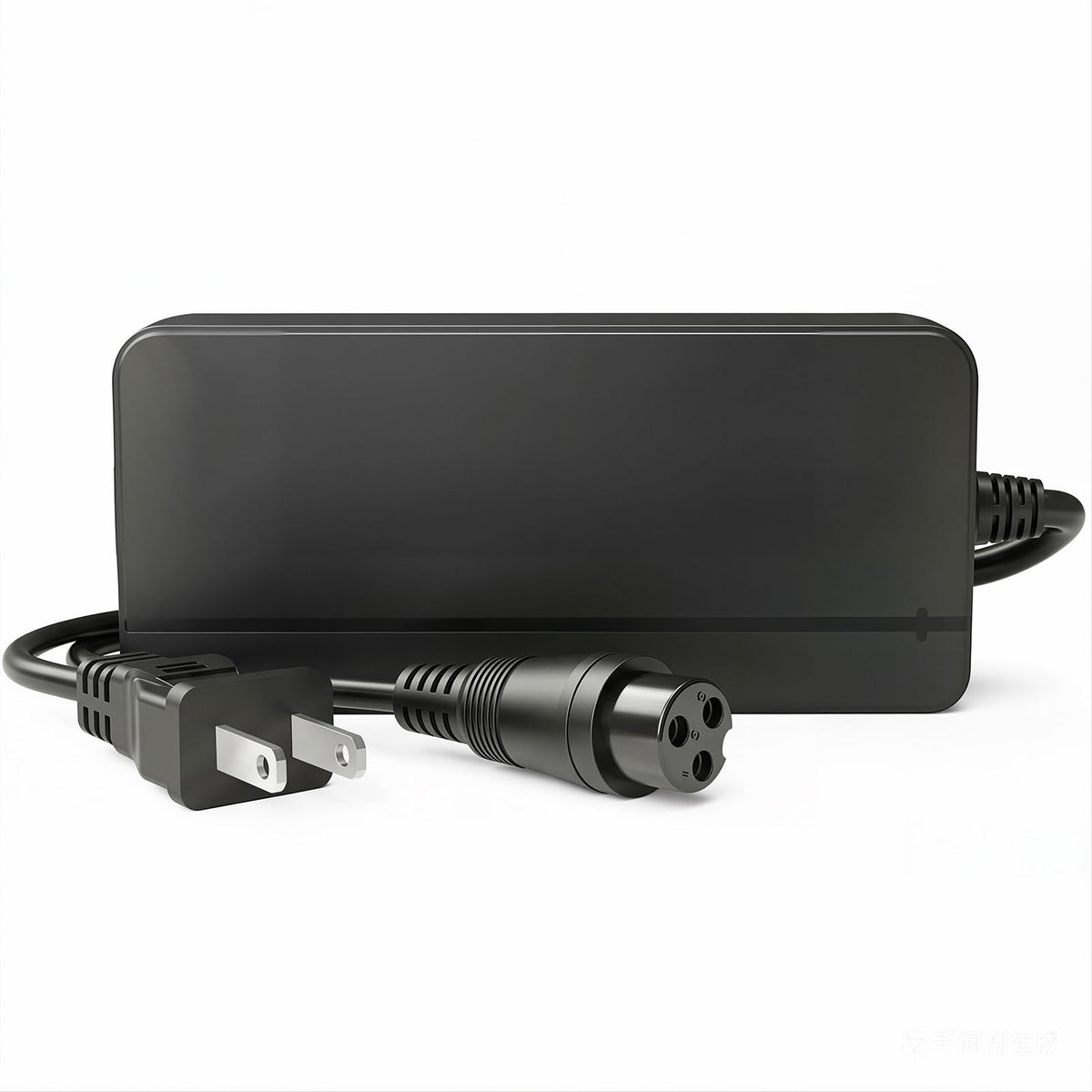
A “60V” electric scooter does not normally use a charger labeled 60V. A common 60V lithium-ion battery is built as a 16-series (16S) pack, and its full-charge voltage is 67.2V. That is why many compatible scooters require a 67.2V charger.
Voltage is only the first check. Before buying a replacement, you must also match the battery chemistry, charging current, connector size, pin layout and polarity. This guide explains how to evaluate a 67.2V 3A charger with a 3-pin GX16-style connector without relying on the scooter name alone.

Quick answer: when does a 60V scooter need a 67.2V charger?
A 67.2V charger is commonly used when all of the following are true:
- The battery is labeled 60V nominal.
- The battery chemistry is lithium-ion, not lead-acid or LiFePO4.
- The pack is a conventional 16S lithium-ion configuration.
- The original charger or manufacturer documentation specifies 67.2V DC output.
- The battery or vehicle supports the charger's current, such as 3A.
- The connector, pin assignment and polarity match exactly.
If any item is unknown, do not connect the charger. Check the original charger label, battery label and scooter manual, or ask the manufacturer to confirm the specification.
Why 67.2V is correct for many 60V lithium-ion batteries
“60V” is the battery's nominal system voltage, not necessarily its voltage when fully charged. A conventional lithium-ion cell reaches about 4.2V at full charge. With 16 cell groups connected in series:
This is why a 16S lithium-ion pack marketed as 60V commonly uses a charger with a 67.2V DC output. The charger should regulate the charging process to the battery system's specified limit.
However, you should not assume that every product marketed as “60V” uses the same chemistry or series configuration. Lead-acid packs, LiFePO4 packs and specialized lithium systems can require different charging profiles and voltages. The original documentation is the authority.
The five checks that determine charger compatibility
| Check | What must match | Where to verify |
|---|---|---|
| Battery chemistry | Lithium-ion | Battery label or manual |
| Charger output | 67.2V DC | Original charger OUTPUT label |
| Charging current | 3A or another approved value | Original charger and battery specification |
| Connector | Same pin count, shell diameter and keying | Old plug and charging port |
| Polarity/pinout | Exact electrical match | Manufacturer diagram or verified label |
Check 1: confirm lithium-ion chemistry
The charger covered here is intended for a compatible 60V (16S) lithium-ion system. Do not use it with a 60V lead-acid battery or a LiFePO4 battery merely because the nominal voltage sounds similar. Different chemistries require different charge limits and control profiles.
Look for wording such as Li-ion or lithium-ion on the battery label. If the label says SLA, AGM, gel, lead-acid or LiFePO4, stop and obtain the charger specified for that chemistry.
Check 2: read OUTPUT, not INPUT
A charger label normally contains both input and output information:
- INPUT describes the wall supply the charger accepts, often AC 100–240V and 50/60Hz.
- OUTPUT describes the DC voltage and current delivered to the battery, such as 67.2V DC and 3A.
For compatibility, compare the OUTPUT line with the original charger or manufacturer specification. Do not mistake a universal AC input range for the battery voltage.

Check 3: is 3A charging approved for your battery?
Charging current affects how quickly energy is returned to the battery, but a higher number is not automatically better. A 3A charger should be used only if the battery, battery-management system, charging port and wiring support that current.
If the original charger is 3A and every other specification matches, replacing it with another correctly specified 3A unit is usually the clearest path. If the original is 2A, do not move to 3A simply to save time unless the scooter or battery manufacturer approves it.
A rough ideal charging-time estimate is:
For example, 20Ah ÷ 3A is about 6.7 hours in idealized arithmetic. Real charging usually takes longer because charging slows near full capacity, the pack may not start fully empty, and charger/BMS behavior varies. Treat the calculation as a planning estimate, not a guaranteed time.
Check 4: match the connector's pin count and physical size
“3-pin connector” is not specific enough. Similar-looking circular connectors can differ in shell diameter, pin spacing, keying and gender. The product shown in this guide uses a 3-pin GX16-style connector with an approximately 12mm shell. An 8mm connector or 4-pin version is not physically equivalent.
Never force a plug into the charging port. If it does not align and insert normally, it is not the correct physical match.

Check 5: verify polarity and pin assignment
Two connectors can fit physically and still be wired differently. Connecting the wrong polarity or pin assignment can damage the charger, charging port, battery-management system or battery.
Use a verified pinout from the manufacturer or an exact match to the original charger's documented configuration. Do not infer polarity solely from wire color, plug shape or an online photo. If the pinout is unavailable, ask the scooter manufacturer or a qualified technician.
What about YUME, Kaabo, VSETT, Apollo and other scooter names?
Some versions of scooters in these families may use a 60V (16S) lithium-ion battery, 67.2V charging output and a compatible 3-pin GX16-style connector. But compatibility must be confirmed for the exact model, production year and battery installed in your scooter.
Do not order based only on a name such as YUME X11, Kaabo Mantis, VSETT 10+ or Apollo Phantom. First compare:
- the original charger OUTPUT label;
- the battery chemistry and nominal voltage;
- the approved charging current;
- the connector's gender, diameter and pin count;
- the polarity and pin assignment.
67.2V 3A versus a universal 7-in-1 charger
BICMDO also offers an in-stock 67.2V 2A/3A charger with multiple plug adapters. A multi-adapter kit can be useful when the exact compatible tip is included, but the same electrical rules still apply. An adapter changes the physical connection; it does not correct the wrong voltage, chemistry, current, polarity or pinout.
If your scooter clearly uses the specific 3-pin connector discussed in this guide, a dedicated connector reduces the number of removable connections. If you need flexibility across compatible vehicles, a multi-tip product may be convenient—but every vehicle must be checked independently.
When you should not use the charger
- The battery chemistry is unknown or is not lithium-ion.
- The original charger output is not 67.2V DC.
- The battery or manufacturer does not approve 3A charging.
- The connector is 8mm, 4-pin, a different gender or otherwise mismatched.
- The polarity or pin assignment cannot be confirmed.
- The port is loose, corroded, melted, burned or damaged.
- The battery is swollen, leaking, unusually hot or has an unusual odor.
- The charger or cable shows cuts, crushed insulation or exposed conductors.
For damaged batteries or charging ports, stop using the scooter and consult the manufacturer or a qualified battery technician.
Safe charging checklist
- Inspect the charger, cables, plug and charging port before every charge.
- Charge on a hard, dry, nonflammable surface with ventilation around the charger.
- Do not cover the charger or place it on a bed, sofa or carpet.
- Keep the charging area away from flammable materials and exit routes.
- Follow the connection and disconnection order in the scooter manual.
- Monitor the first charge with a replacement charger.
- Stop immediately for smoke, sparking, strong odor, abnormal noise or excessive heat.
- Do not charge a frozen, wet or visibly damaged battery.
Some warmth can be normal, but excessive heat is a warning sign. See Is It Normal for an E-Bike Charger to Get Hot? and How to Tell If Your E-Bike Charger Is Bad for additional troubleshooting guidance.
Frequently asked questions
Can I use a 60V charger on a 60V scooter?
Do not choose by the marketing name alone. Many 60V 16S lithium-ion packs require 67.2V charging output. Match the original charger's OUTPUT specification and battery documentation.
Can I use a 72V charger on a 60V battery?
No. A charger intended for a higher-voltage battery can exceed the 60V pack's charging limit and create a serious safety hazard.
Can I use a 67.2V charger on every 60V battery?
No. Battery chemistry and configuration matter. Confirm that the pack is a compatible 16S lithium-ion system that explicitly requires 67.2V charging.
Is 3A a fast charger?
It is faster than 2A under comparable conditions, but whether it is appropriate depends on the battery's approved charge current. Never increase current without confirmation.
Does a GX16-3 plug guarantee compatibility?
No. Verify shell size, gender, keying, polarity and pin assignment in addition to the GX16-3 description.
What information should I send for a compatibility check?
Send clear photos of the scooter model label, battery label, original charger INPUT/OUTPUT label, charging port, and old connector from multiple angles. Include measurements of the connector shell when possible.
Check the BICMDO 67.2V 3A scooter charger
This in-stock replacement charger is listed for compatible 60V (16S) lithium-ion scooters requiring 67.2V DC output, 3A current and the matching 3-pin GX16-style connector.
View the 67.2V 3A scooter charger →
Compatibility depends on the exact battery and scooter version. Confirm chemistry, output, current, connector and polarity before ordering.
Share:
Pride Go-Go Mobility Scooter Charger Guide: How to Match 29V, Lead-Acid and 3-Pin XLR
Super73 Replacement Charger Guide: Match 54.6V, Amps and Connector