

Introduction
It is normal for an electric bike charger to become warm during operation. However, excessive heat or unusual symptoms may indicate a potential issue that should not be ignored. In this article, we will explain why e-bike chargers generate heat, what is considered normal, and how to safely use and maintain your charger.
1. Is It Normal for an E-Bike Charger to Get Hot?
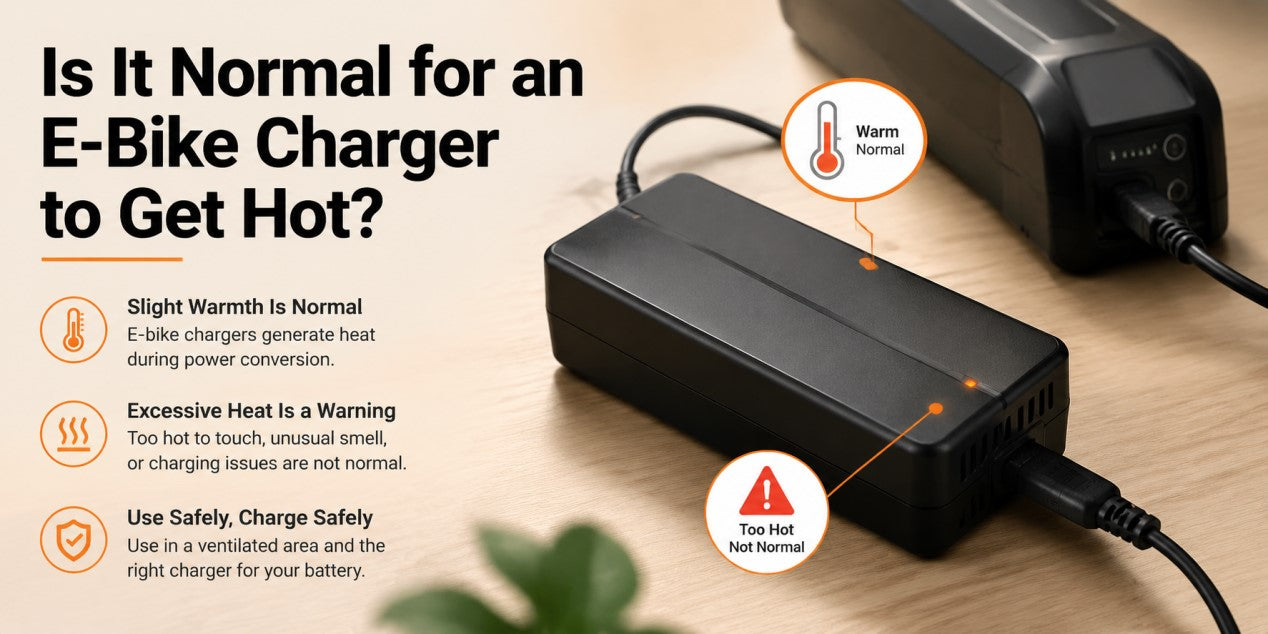
Yes — in most cases, a warm charger is completely normal. E-bike chargers convert AC power into DC power to charge the battery. During this conversion process, some energy is lost as heat.
Normal conditions include:
- The charger feels warm to the touch
- Temperature increases during charging
- The charger cools down after use
👉 These conditions are generally expected during normal operation.
2. When Is Charger Heat NOT Normal?
You should be cautious if you notice:
- The charger becomes too hot to touch
- A burning or plastic smell
- Charging stops unexpectedly or behaves abnormally
- The casing becomes deformed or discolored
- Loud buzzing or unusual noise
👉 These signs may indicate internal stress or component failure.
3. Why Do E-Bike Chargers Heat Up?

1. Energy Conversion Loss
All chargers generate heat when converting voltage levels. This is a basic electrical characteristic.
2. High Ambient Temperature
Charging in hot environments reduces heat dissipation efficiency.
3. Poor Ventilation
Placing the charger on soft surfaces (like beds or carpets) can trap heat.
4. High Power Output
Higher wattage chargers (such as fast chargers) naturally generate more heat during operation.
5. Voltage or Compatibility Mismatch
Using a charger that does not match your battery specifications can increase stress and heat generation.
4. How to Tell If It Is Safe
A simple guide:
| Condition | Status |
|---|---|
| Warm but stable | Normal |
| Hot but no smell | Monitor |
| Very hot + smell | Stop using |
| Deformation | Unsafe |
One of the most common causes of abnormal heating is using a charger that is not properly matched with the battery voltage or connector type. Universal chargers with multiple connector options can help reduce compatibility issues and improve user convenience.
5. How to Reduce Charger Heat

- Use the charger in a well-ventilated area
- Avoid covering the charger during use
- Keep away from direct sunlight
- Ensure correct voltage matching with your battery system
- Use chargers with built-in protection systems
6. When Should You Replace Your Charger?
Consider replacing your charger if:
- It consistently overheats
- Charging performance becomes unstable
- Physical damage is visible
- Safety indicators repeatedly trigger errors
In some cases, using a charger with better thermal management and built-in protection systems can help improve charging stability and reduce unnecessary heat buildup. For example, multi-protection chargers with over-temperature, over-voltage, and short-circuit protection are designed to maintain safer operation under different charging conditions.
Example of a compatible upgraded charger:
BICMDO 67.2V 3A E-Bike Charger – 7-in-1 Plugs
7. Conclusion
Some level of heat is expected during e-bike charging, but it should remain within a safe and stable range. Proper usage, correct voltage matching, and good ventilation are key to maintaining safe charging conditions. If abnormal heating occurs, stop using the charger and inspect the system carefully.
If a charger shows repeated overheating issues or inconsistent performance, replacing it with a certified, properly matched charger is recommended. Many riders choose upgraded chargers with built-in protection and multi-connector compatibility to ensure safer daily charging.
BICMDO Offers:
- FREE SHIPPING:Fast delivery support for eligible orders.
- YEAR WARRANTY:Warranty coverage for more confident ownership.
- DAY RETURN:Return support designed for easier online shopping.
- SUPPORT TEAM:Helpful guidance before and after your ride.
E-Bike Battery FAQ
1. What does 48V mean on an e-bike battery?
A “48V” battery refers to the nominal voltage of the battery pack, not the actual full charge voltage. Most 48V lithium-ion e-bike batteries are made of 13 series cells (13S), with a full charge voltage of 54.6V.
2. What is the difference between 36V, 48V, and 52V batteries?
The main difference is voltage, which affects power output and speed capability:
- 36V system: standard commuting use
- 48V system: balanced power and range
- 52V system: higher performance and torque
Always use a charger that matches the correct battery voltage.
3. Can I use any charger for my e-bike battery?
No. You should only use a charger that matches:
- Battery voltage (e.g., 36V, 48V, 52V)
- Battery chemistry (lithium-ion or lead-acid)
- Connector type
Using an incompatible charger may affect performance or battery lifespan.
4. What happens if I use the wrong charger?
Using the wrong charger may lead to:
- Incomplete charging
- Reduced battery lifespan
- Excess heat during charging
- Battery management system (BMS) protection shutdown
In some cases, the battery may refuse to charge for safety reasons.
5. How long does it take to charge an e-bike battery?
Charging time depends on:
- Battery capacity (Ah)
- Charger output current (A)
Typical charging time is 4–8 hours under standard conditions. Fast chargers may reduce charging time but can generate more heat.
6. Is it normal for an e-bike battery or charger to get warm?
Yes. Slight warming during charging is normal due to energy conversion. However, excessive heat, unusual smell, or deformation should be treated as a warning sign, and charging should be stopped immediately.
7. Can I leave my e-bike battery charging overnight?
It is generally recommended to avoid unattended charging for long periods. Modern batteries with a BMS system provide protection, but safety practices depend on charger quality, environment, and battery condition.
8. How can I extend my e-bike battery lifespan?
To extend battery life:
- Avoid full discharge before charging
- Use the correct charger
- Store in a cool, dry place
- Avoid extreme temperatures
- Do not overcharge repeatedly
9. What is a BMS in an e-bike battery?
BMS stands for Battery Management System. It helps protect the battery from:
- Overcharging
- Over-discharging
- Overcurrent
- Overheating
It is an important safety component in lithium battery systems.
10. Why does my battery not fully charge?
Common reasons include:
- Charger mismatch
- Battery aging
- BMS protection activation
- Temperature conditions
- Loose or incompatible connectors
11. Do fast chargers damage e-bike batteries?
Fast chargers do not automatically damage batteries, but higher current may increase heat generation. It is important to use a charger that is designed for your specific battery system.
12. How do I know which charger I need?
Check the battery label for:
- Voltage (36V / 48V / 52V)
- Chemistry type (Lithium-ion / Lead-acid)
- Connector type
Then choose a charger that matches these specifications exactly.
Share:
Super73 Battery Care Guide — Secrets to Extend Battery Life
Can You Use a 54.6V Charger for a 48V E-Bike Battery? Safety Guide & Compatibility Explained