

Introduction
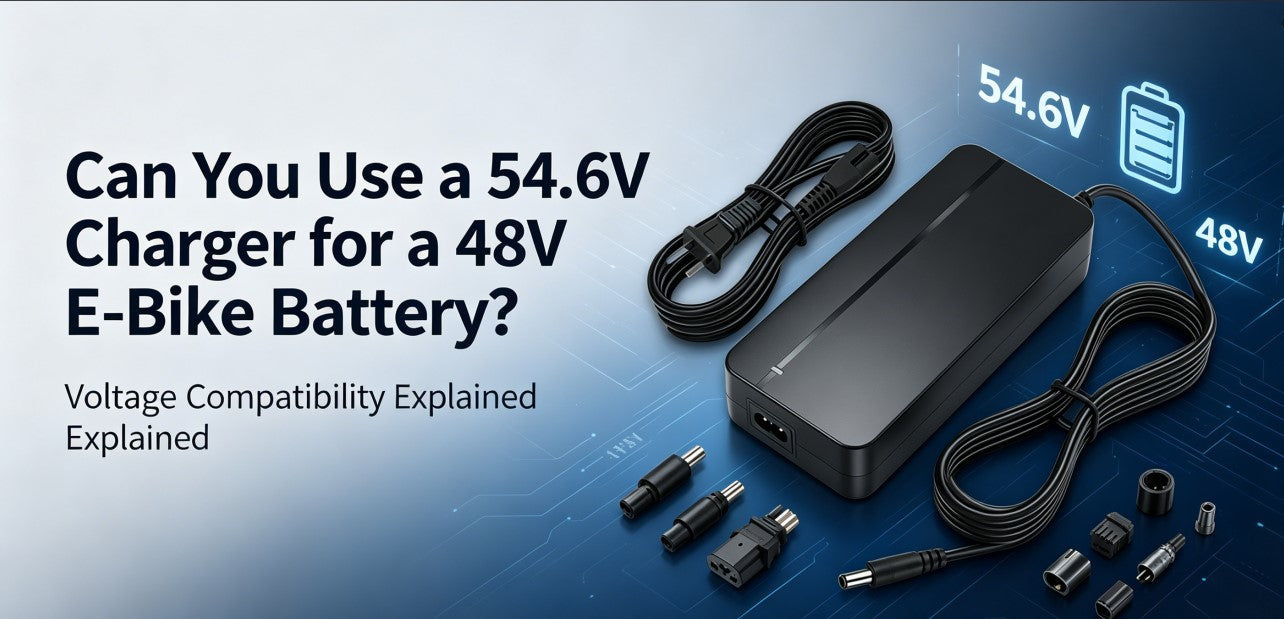
A common question among e-bike users is whether a 54.6V charger can be used to charge a 48V battery system. The short answer is: it depends on the battery chemistry and system design.
Using the wrong charger can affect battery performance and safety, so understanding voltage compatibility is important. In this article, we will explain the relationship between 48V batteries and 54.6V chargers, and how to choose the correct charger safely.
1. Why Is a 48V Battery Charged at 54.6V?

A “48V lithium battery” does not actually charge at 48V. Most 48V lithium-ion battery packs are made of:
- 13 series cells (13S configuration)
Each cell charges up to:
- 4.2V
So the full charging voltage becomes:
4.2V × 13 = 54.6V
This means: A 54.6V charger is typically the standard full-charge voltage for 48V lithium battery systems.
2. Is It Safe to Use a 54.6V Charger for a 48V Battery?
✔️ In most lithium-ion systems:
Yes — a 54.6V charger is the correct and standard charger for a 48V lithium battery. However, safety depends on several conditions:
- Battery chemistry (Lithium-ion vs Lead-acid)
- Battery management system (BMS)
- Charger quality and protection features
3. When It Is NOT Safe
You should NOT use a 54.6V charger if:
- The battery is not lithium-ion (e.g., lead-acid systems)
- The manufacturer specifies a different charging voltage
- The battery label does not match 13S lithium configuration
- The charger is not designed for your connector or system
Using an incorrect charger may lead to:
- Overcharging risk
- Reduced battery lifespan
- BMS triggering safety shutdowns
4. What Happens If You Use the Wrong Charger?

If voltage is not matched properly, you may experience:
- Excess heat during charging
- Battery not reaching full capacity
- Reduced cycle life
- Charging errors or interruptions
In some cases, the battery management system (BMS) will stop charging automatically for protection.
5. How to Choose the Correct E-Bike Charger
When selecting a charger, always check:
✔ Battery voltage compatibility
- 36V system → 42V charger
- 48V system → 54.6V charger
- 52V system → 58.8V charger
✔ Battery chemistry
- Lithium-ion vs lead-acid
✔ Connector type
- DC plug / XT60 / aviation plug / etc.
✔ Protection features
- Over-voltage protection
- Over-current protection
- Temperature protection
- Short-circuit protection
6. A Safer Charging Option
In real-world use, many riders prefer chargers that offer:
- Stable output voltage
- Built-in safety protections
- Multiple connector compatibility
- Better thermal management
These features help reduce compatibility issues and improve long-term battery safety.
Example of a compatible e-bike charger:
BICMDO 67.2V 3A E-Bike Charger – 7-in-1 Plugs
7. Conclusion
In most lithium-ion e-bike systems, a 54.6V charger is the correct and standard choice for a 48V battery. However, compatibility depends on battery type, system design, and manufacturer specifications. To ensure safety and battery longevity, always verify voltage requirements and use a properly matched charger with built-in protection features.
BICMDO Offers:
- FREE SHIPPING:Fast delivery support for eligible orders.
- YEAR WARRANTY:Warranty coverage for more confident ownership.
- DAY RETURN:Return support designed for easier online shopping.
- SUPPORT TEAM:Helpful guidance before and after your ride.
E-Bike Battery FAQ
1. What does 48V mean on an e-bike battery?
A “48V” battery refers to the nominal voltage of the battery pack, not the actual full charge voltage. Most 48V lithium-ion e-bike batteries are made of 13 series cells (13S), with a full charge voltage of 54.6V.
2. What is the difference between 36V, 48V, and 52V batteries?
The main difference is voltage, which affects power output and speed capability:
- 36V system: standard commuting use
- 48V system: balanced power and range
- 52V system: higher performance and torque
Always use a charger that matches the correct battery voltage.
3. Can I use any charger for my e-bike battery?
No. You should only use a charger that matches:
- Battery voltage (e.g., 36V, 48V, 52V)
- Battery chemistry (lithium-ion or lead-acid)
- Connector type
Using an incompatible charger may affect performance or battery lifespan.
4. What happens if I use the wrong charger?
Using the wrong charger may lead to:
- Incomplete charging
- Reduced battery lifespan
- Excess heat during charging
- Battery management system (BMS) protection shutdown
In some cases, the battery may refuse to charge for safety reasons.
5. How long does it take to charge an e-bike battery?
Charging time depends on:
- Battery capacity (Ah)
- Charger output current (A)
Typical charging time is 4–8 hours under standard conditions. Fast chargers may reduce charging time but can generate more heat.
6. Is it normal for an e-bike battery or charger to get warm?
Yes. Slight warming during charging is normal due to energy conversion. However, excessive heat, unusual smell, or deformation should be treated as a warning sign, and charging should be stopped immediately.
7. Can I leave my e-bike battery charging overnight?
It is generally recommended to avoid unattended charging for long periods. Modern batteries with a BMS system provide protection, but safety practices depend on charger quality, environment, and battery condition.
8. How can I extend my e-bike battery lifespan?
To extend battery life:
- Avoid full discharge before charging
- Use the correct charger
- Store in a cool, dry place
- Avoid extreme temperatures
- Do not overcharge repeatedly
9. What is a BMS in an e-bike battery?
BMS stands for Battery Management System. It helps protect the battery from:
- Overcharging
- Over-discharging
- Overcurrent
- Overheating
It is an important safety component in lithium battery systems.
10. Why does my battery not fully charge?
Common reasons include:
- Charger mismatch
- Battery aging
- BMS protection activation
- Temperature conditions
- Loose or incompatible connectors
11. Do fast chargers damage e-bike batteries?
Fast chargers do not automatically damage batteries, but higher current may increase heat generation. It is important to use a charger that is designed for your specific battery system.
12. How do I know which charger I need?
Check the battery label for:
- Voltage (36V / 48V / 52V)
- Chemistry type (Lithium-ion / Lead-acid)
- Connector type
Then choose a charger that matches these specifications exactly.
Share:
Is It Normal for an E-Bike Charger to Get Hot?
Can I Use a 48V Charger on 36V or 52V E-Bike Batteries? Ebike Chargers Safety Guide