
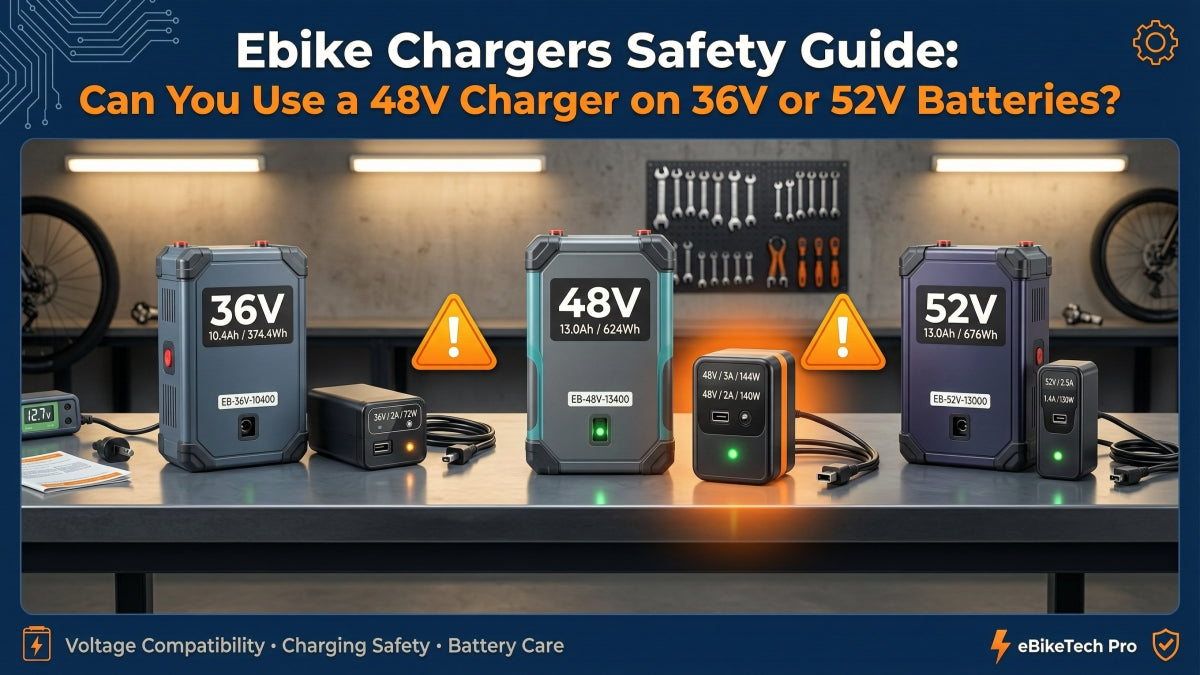
Introduction: Why Ebike Chargers Must Match the Battery
Ebike Chargers are not simple accessories. They are one of the most important safety components in your electric bike system. Many riders focus on motor power, battery range, tire size, suspension, or riding speed, but they often overlook the charger until something goes wrong. A charger that looks similar, uses the same plug, or fits into the charging port is not automatically safe for your battery.

One of the most common questions riders ask is whether they can use a 48V charger on a 36V ebike battery. Another frequent question is whether a 48V charger can be used on a 52V ebike battery. These questions are important because using the wrong charger can lead to poor charging performance, shortened battery life, battery management system shutdown, overheating, swelling, electrical failure, or even fire hazards in extreme cases.
The short answer is simple: you should not use a 48V charger on a 36V e-bike battery. A 48V charger outputs a much higher final charging voltage than a 36V battery is designed to accept. For a 52V battery, a 48V charger is usually not dangerous in the same way, but it is also not the correct charger because it cannot fully charge a 52V lithium battery pack.
This guide explains the difference between 36V, 48V, and 52V electric bike batteries, how lithium-ion charging voltage works, why the number on the charger label matters, and how to choose safer, more compatible Ebike Chargers for your ride. Whether you ride a commuter e-bike, fat tire e-bike, cargo e-bike, folding e-bike, scooter-style e-bike, or a Super73-style 48V system, understanding charger compatibility can help you protect your battery investment and ride with confidence.
Quick Answer: Can You Use a 48V Charger on a 36V or 52V E-Bike Battery?
If you need a fast answer before reading the full guide, here is the safest summary:
| Question | Short Answer | Reason | Safety Level |
|---|---|---|---|
| Can I use a 48V charger on a 36V ebike battery? | No. Do not do this. | A 48V charger usually outputs 54.6V, while a 36V lithium battery usually requires 42V. | Dangerous / Not recommended |
| Can I use a 48V charger on a 52V ebike battery? | Usually not recommended. | A 48V charger is lower than the full-charge voltage of a 52V battery, so it may undercharge the pack. | Generally not ideal |
| Can I use a charger if the plug fits? | No, not based on plug fit alone. | Voltage, chemistry, current, polarity, and connector type must all match. | Check first |
| What is the correct charger for a 36V lithium e-bike battery? | Usually a 42V charger. | Most 36V lithium-ion packs are 10S packs with a full charge voltage of 42V. | Correct if specs match |
| What is the correct charger for a 48V lithium e-bike battery? | Usually a 54.6V charger. | Most 48V lithium-ion packs are 13S packs with a full charge voltage of 54.6V. | Correct if specs match |
| What is the correct charger for a 52V lithium e-bike battery? | Usually a 58.8V charger. | Most 52V lithium-ion packs are 14S packs with a full charge voltage of 58.8V. | Correct if specs match |
The key rule is this: match the charger output voltage to the battery’s required charging voltage, not only to the battery’s nominal voltage. A battery labeled 48V does not charge with exactly 48V. A 48V lithium battery usually needs a charger with a 54.6V output. This is why reading the charger label is essential.
Understanding E-Bike Battery Voltage and Charger Output
To understand why charger compatibility matters, you first need to understand the difference between nominal voltage and full-charge voltage. Many e-bike batteries are labeled with a simple number such as 36V, 48V, 52V, or 60V. This number is the nominal voltage, which means the general operating voltage of the battery system. It is not the exact voltage the charger outputs.
Most modern electric bike batteries use lithium-ion cells. A common lithium-ion cell has a nominal voltage of around 3.6V or 3.7V and a full-charge voltage of 4.2V per cell. E-bike battery packs are created by connecting multiple cells in series. This is often described as 10S, 13S, 14S, and so on. The “S” means cells or cell groups connected in series.
For example, a typical 36V e-bike battery is usually a 10S lithium-ion pack. When fully charged, each series group reaches 4.2V. Therefore, the pack reaches 42V at full charge. A typical 48V battery is often a 13S pack, so its full-charge voltage is 13 × 4.2V = 54.6V. A typical 52V battery is usually a 14S pack, so its full-charge voltage is 14 × 4.2V = 58.8V.
Ebike Chargers Must Match Full-Charge Voltage
This is the point many riders miss: Ebike Chargers are labeled by their output voltage, not just by the battery name. A charger sold as a 48V e-bike charger commonly has a DC output of 54.6V. That voltage is correct for many 48V lithium battery packs, but it is much too high for a 36V lithium battery pack.
If a 36V battery is designed to stop charging at 42V, connecting it to a 54.6V charger may force the battery far beyond its safe voltage limit. If the battery management system catches the problem, it may shut off charging. If it fails, is low-quality, damaged, or bypassed, the battery can be seriously damaged.
On the other hand, a 52V battery typically needs 58.8V to reach a full charge. A 54.6V charger may partially charge it, but it will not bring it to full capacity. This can lead to reduced range, inaccurate battery readings, charging confusion, and poor performance.
Can I use a 48V charger on a 36V ebike battery?
No, you should not use a 48V charger on a 36V ebike battery. This is one of the most important warnings in e-bike charging safety. A 48V lithium e-bike charger typically outputs about 54.6V. A 36V lithium e-bike battery typically requires a charger output of about 42V. That means a 48V charger may deliver more than 12 volts above the safe full-charge voltage of a 36V battery.
This voltage difference is not small. In lithium battery systems, overvoltage is one of the most dangerous charging mistakes. A battery pack is designed with a specific number of cells in series. A 36V lithium battery usually has 10 cell groups in series. Charging those 10 groups as if they were 13 groups can push the cells beyond their safe maximum voltage.
Why a 48V Charger Is Dangerous for a 36V Battery
A 36V lithium-ion battery pack is normally considered fully charged at 42V. If you connect a 54.6V charger, the charger is trying to raise the battery voltage toward 54.6V. That is far beyond the normal limit of the cells. The battery’s BMS may interrupt charging, but you should never rely on the BMS as your primary safety plan.
Possible risks include:
- Overcharging: The cells may be pushed beyond their designed full-charge voltage.
- Overheating: Excess voltage can cause heat buildup inside the pack.
- BMS shutdown: The battery management system may cut off the charging circuit to prevent damage.
- Cell imbalance: Some cell groups may rise faster than others, increasing stress and risk.
- Reduced battery life: Even one incorrect charging event can weaken cells.
- Battery swelling or failure: Severe overcharging can damage the internal chemistry.
- Fire risk: In extreme cases, lithium battery overcharging can become a serious safety hazard.
What If the Plug Fits the 36V Battery?
The plug fitting does not mean the charger is safe. Many Ebike Chargers use similar barrel connectors, 3-pin connectors, XLR-style connectors, or adapter plugs. Some universal chargers include multiple plug tips. This is convenient, but it also creates a risk: a physically compatible plug can still be electrically incompatible.
Before using any charger, you must confirm:
- The charger output voltage matches the battery charging voltage.
- The charger current is within the battery manufacturer’s accepted range.
- The connector polarity is correct.
- The plug type is correct and secure.
- The charger is designed for the same battery chemistry.
- The charger has reliable safety protections.
A 48V charger may fit into a 36V battery port, but it should not be used if the output voltage is not correct. When in doubt, stop and check the battery label, original charger label, user manual, or contact the battery or charger supplier.
What Charger Should You Use for a 36V E-Bike Battery?
For most 36V lithium-ion e-bike batteries, the correct charger is a 42V lithium battery charger. The current may vary depending on the battery capacity and manufacturer recommendation. Common charging currents include 2A, 3A, or sometimes higher for compatible packs. However, voltage must be correct first. A 2A charger with the wrong voltage is not safe simply because the current is low.
For example, a 36V 10Ah lithium battery may commonly use a 42V 2A charger. A larger 36V 15Ah or 20Ah battery might support 42V 3A charging if recommended by the manufacturer. But using 54.6V on that same battery is not appropriate.
Featured Snippet Answer: Can I Use a 48V Charger on a 36V Ebike Battery?
No. A 48V e-bike charger should not be used on a 36V e-bike battery because most 48V lithium chargers output 54.6V, while a 36V lithium battery usually requires 42V. Using the wrong charger can overcharge the battery, trigger BMS shutdown, damage cells, reduce battery life, or create a safety hazard.
Can I use a 48V charger on a 52V ebike battery?
A 48V charger is usually not the correct charger for a 52V ebike battery. However, the situation is different from using a 48V charger on a 36V battery. A 48V charger is too high for a 36V battery, but it is too low for a 52V battery. Most 52V lithium e-bike batteries require a 58.8V charger for a full charge. A 48V lithium charger commonly outputs 54.6V, which is below the full-charge voltage of a 52V pack.
In many cases, a 48V charger may not fully charge a 52V battery. It may stop early, charge only partially, or fail to start depending on the battery management system and charger design. It is generally less dangerous than overcharging a 36V battery with a 48V charger, but it is still not the ideal charging method.
Why a 48V Charger Undercharges a 52V Battery
A 52V lithium battery is usually a 14S pack. At full charge, each series group reaches about 4.2V. The total full-charge voltage is therefore 58.8V. A 48V charger designed for a 13S pack usually stops at 54.6V. That means the charger cannot bring the 52V battery to full capacity.
When a 52V battery is charged only to 54.6V, it may still power the bike, but it will not provide the same range as a full charge. The battery display may show a lower percentage, the voltage-based battery meter may be inaccurate, and the rider may think the battery is aging when the real issue is simply the wrong charger.
Is Undercharging a 52V Battery Bad?
Partial charging is not always harmful. In fact, many lithium battery users intentionally avoid charging to 100% every time to extend long-term battery life. However, using the wrong charger is different from using a correct charger with an intentional charge limit. A proper smart charger or charging system is designed to stop at selected voltage levels safely. A mismatched 48V charger is not necessarily designed to communicate with or properly manage a 52V battery system.
Potential problems include:
- Reduced range: The battery will not reach its full energy capacity.
- Inaccurate battery meter: The bike display may not correctly estimate remaining charge.
- Charging cutoff confusion: The charger may indicate “full” even though the battery is not truly full.
- BMS compatibility issues: Some battery systems may not accept the charger properly.
- Cell balancing limitations: Some BMS balancing functions occur near the top of charge, so chronic undercharging may reduce balancing opportunities.
- Poor performance: The bike may start at a lower voltage and feel less powerful under load.
Can a 48V Charger Be Used Temporarily on a 52V Battery?
Some riders ask whether using a 48V charger on a 52V battery is acceptable in an emergency. In theory, because the voltage is lower than the battery’s full-charge voltage, it may partially charge certain 52V batteries. But this depends on the charger, the BMS, the connector, and the system design. It should not be treated as a normal long-term charging solution.
If you are stranded and considering emergency charging, you should verify the charger output, connector polarity, battery chemistry, and manufacturer guidance. If anything is uncertain, do not connect the charger. The safer solution is to use the correct 58.8V charger for a 52V lithium battery.
What Charger Should You Use for a 52V E-Bike Battery?
For most 52V lithium-ion e-bike batteries, the correct charger is a 58.8V lithium battery charger. The charging current should match the battery’s supported range. Common options include 2A for slower charging, 3A for balanced everyday charging, and higher amperage for compatible large-capacity packs. Always follow the battery manufacturer’s recommendation.
If you ride a high-performance e-bike or a long-range fat tire model with a 52V battery, choosing the right charger is especially important. A high-capacity pack is expensive, and repeated use of the wrong charger can reduce convenience, performance, and battery management accuracy.
Featured Snippet Answer: Can I Use a 48V Charger on a 52V Ebike Battery?
A 48V e-bike charger is usually not recommended for a 52V e-bike battery because most 48V lithium chargers output 54.6V, while a 52V lithium battery usually needs 58.8V to fully charge. It may partially charge the battery, but it can reduce range, cause inaccurate battery readings, and may not support proper battery balancing.
Ebike Chargers Voltage Compatibility Table
The table below summarizes common lithium e-bike battery voltages and their typical charger output voltages. This is a general guide for lithium-ion e-bike batteries. Always confirm the exact specifications of your battery before charging.
| Battery Label | Common Cell Configuration | Typical Full-Charge Voltage | Correct Charger Output | Can You Use a 48V Charger? |
|---|---|---|---|---|
| 24V Battery | 7S lithium-ion | 29.4V | 29.4V charger | No, far too high |
| 36V Battery | 10S lithium-ion | 42V | 42V charger | No, dangerous overvoltage risk |
| 48V Battery | 13S lithium-ion | 54.6V | 54.6V charger | Yes, if output, plug, current, polarity, and chemistry match |
| 52V Battery | 14S lithium-ion | 58.8V | 58.8V charger | Not ideal; may undercharge |
| 60V Battery | 16S lithium-ion | 67.2V | 67.2V charger | No, too low and incompatible |
| 72V Battery | 20S lithium-ion | 84V | 84V charger | No, too low and incompatible |
This table shows why the word “48V” can be confusing. A 48V charger is suitable for many 48V lithium e-bike batteries, but not for 36V batteries and not ideal for 52V batteries. The correct choice depends on the actual charger output voltage.
Why Is a 48V E-Bike Charger Actually 54.6V?
Many riders are surprised when they look at the label on their 48V charger and see “Output: 54.6V.” This is normal for a 48V lithium-ion e-bike battery system. The 48V number is the nominal battery voltage, while 54.6V is the full-charge voltage.
A typical 48V lithium battery is made from 13 cell groups connected in series. Each group charges to about 4.2V at full charge. The calculation is:
13 × 4.2V = 54.6V
That is why a charger for a 48V lithium battery commonly outputs 54.6V. It is not a mistake or an overpowered charger. It is the correct charging voltage for many 13S lithium-ion e-bike batteries.
Ebike Chargers Are Designed Around Battery Chemistry
Different battery chemistries require different charging profiles. Most e-bike lithium-ion chargers use a constant-current and constant-voltage charging process. During the first stage, the charger supplies a controlled current while the battery voltage rises. During the second stage, the charger holds the voltage at the target level while current gradually decreases. When the current drops low enough, the charger stops or switches to a fully charged state.
This charging process depends on the correct voltage target. If the voltage target is too high, the battery may be overcharged. If it is too low, the battery may not fully charge. That is why selecting the correct charger is not optional—it is part of safe battery operation.
Major Risks of Using the Wrong E-Bike Charger
Using the wrong charger is one of the fastest ways to damage an e-bike battery. A charger is not only a power adapter. It controls voltage and current during a sensitive chemical charging process. When the charger does not match the battery, the results can range from mild inconvenience to serious safety hazards.
1. Overvoltage Damage
Overvoltage occurs when the charger output is higher than the battery’s maximum safe charging voltage. This is the main risk when using a 48V charger on a 36V battery. Lithium-ion cells are sensitive to overcharging. When pushed beyond their limit, they may heat up, degrade quickly, vent gas, swell, or fail.
2. Overheating
Heat is one of the biggest enemies of lithium batteries. A mismatched charger can cause abnormal current flow, stress the BMS, or push cells into unsafe voltage zones. If the charger or battery becomes unusually hot, unplug it immediately and inspect the system before charging again.
3. BMS Stress or Failure
The battery management system is designed to monitor and protect the battery. However, it is not a substitute for using the right charger. Repeatedly connecting the wrong charger can stress protective circuits. A damaged BMS may fail to balance cells, may shut the battery down, or may stop protecting the pack correctly.
4. Reduced Battery Life
Even when a wrong charger does not cause immediate failure, it may shorten battery life. Overcharging, overheating, unstable charging, and poor balancing can reduce capacity over time. Since e-bike batteries are often one of the most expensive components of the bike, protecting battery health is financially important.
5. Poor Riding Range
Using a charger with voltage that is too low can leave the battery undercharged. This is common when attempting to use a 48V charger on a 52V battery. The bike may still work, but range may be noticeably reduced. Riders may wrongly assume the battery is defective when the real problem is an incompatible charger.
6. Connector and Polarity Problems
Some chargers share similar connector shapes but use different wiring or polarity. Connecting a charger with reversed polarity can damage the battery charging port, BMS, or charger. Multi-plug chargers are useful, but users must still confirm polarity and compatibility.
7. Fire and Safety Hazards
Severe charger mismatch, damaged cells, low-quality chargers, or poor charging conditions can increase fire risk. While many modern batteries include protection systems, lithium battery charging should always be treated seriously. Use the correct charger, charge in a safe location, and avoid leaving a questionable setup unattended.
Can the BMS Protect the Battery from the Wrong Charger?
A battery management system, or BMS, is an electronic protection system inside many lithium e-bike batteries. It may monitor cell voltage, pack voltage, current, temperature, and sometimes balancing. A good BMS can help prevent overcharge, over-discharge, short circuits, and overheating.
However, you should not rely on the BMS to make an incompatible charger safe. The BMS is a last line of defense, not permission to use any charger that fits.
What a BMS May Do
- Stop charging if pack voltage becomes too high.
- Stop discharging if voltage becomes too low.
- Cut off current during short-circuit or overcurrent events.
- Monitor temperature in some battery packs.
- Balance cell groups near the top of charge in some systems.
What a BMS Cannot Guarantee
- It cannot make a 54.6V charger correct for a 42V battery.
- It cannot always prevent damage if the charger voltage is extremely mismatched.
- It may fail if the battery is old, low-quality, modified, or damaged.
- It may not protect against reversed polarity or incorrect connector wiring.
- It may not correct long-term undercharging problems on a 52V system.
Think of the BMS like a seatbelt. It improves safety, but it does not mean you should intentionally drive into danger. The safer approach is to choose Ebike Chargers that match the battery specifications from the beginning.
How to Check If Your E-Bike Charger Is Compatible
Before connecting any charger to an e-bike battery, take a few minutes to verify compatibility. This simple checklist can prevent expensive mistakes.
Step 1: Read the Battery Label
Look for the battery label on the case, underside, mounting rail, or user manual. It may show information such as nominal voltage, capacity, chemistry, and charge voltage. Examples include:
- 36V 10Ah lithium-ion battery
- 48V 15Ah Li-ion battery
- 52V 20Ah lithium battery
- Charging voltage: 42V
- Charging voltage: 54.6V
- Charging voltage: 58.8V
Step 2: Read the Charger Label
The charger label should show input and output information. The most important part is the DC output voltage and current. For example:
- Output: 42V 2A
- Output: 54.6V 2A
- Output: 54.6V 3A
- Output: 58.8V 2A
- Output: 67.2V 5A
Match the charger output voltage to the battery’s required charging voltage. Do not rely only on the marketing name of the charger.
Step 3: Confirm Battery Chemistry
Most modern e-bike batteries are lithium-ion, but some older or specialty systems may use lead-acid, LiFePO4, or other chemistries. The charging voltage and charging profile differ by chemistry. A charger designed for one chemistry should not automatically be used for another.
Step 4: Check Charging Current
Charging current is measured in amps. A lower-current charger usually charges more slowly. A higher-current charger charges faster but must be supported by the battery. For example, many riders use 2A for overnight charging and 3A or higher for faster charging when the battery supports it.
Too much charging current can increase heat and stress. If your battery manual says maximum charge current is 2A, do not use a 5A charger. If you are not sure, choose the current recommended by the battery manufacturer.
Step 5: Check Connector Type and Polarity
Common e-bike charging connectors include DC barrel plugs, 3-pin connectors, XLR-style connectors, aviation connectors, Rosenberger-style magnetic connectors, and brand-specific ports. Some chargers include multiple adapter plugs. While multi-plug designs can improve compatibility, the electrical specifications still matter.
Polarity is also important. The center pin may be positive or negative depending on the system. Reversed polarity can cause immediate damage.
Step 6: Choose a Charger with Safety Protections
Quality Ebike Chargers should include protection features such as overvoltage protection, overcurrent protection, short-circuit protection, temperature control, and automatic shutoff. Certifications and clear labeling also help users identify safer charging products.
How to Choose the Right Ebike Chargers for Your Battery
Choosing the right charger is not only about voltage. A good charger should be safe, reliable, compatible, and convenient for daily riding. When writing product pages or category pages for SEO, it is also important to explain these selection factors clearly because many riders search for answers before buying.
1. Match the Output Voltage
This is the most important rule. The charger output voltage must match the battery’s required charging voltage. For most lithium-ion e-bike systems:
- 36V battery: use a 42V charger.
- 48V battery: use a 54.6V charger.
- 52V battery: use a 58.8V charger.
- 60V battery: use a 67.2V charger.
- 72V battery: use an 84V charger.
2. Select the Right Charging Current
A 2A charger is common for slower, cooler charging. A 3A charger offers a balance between speed and battery care for many compatible packs. A 5A charger can be useful for large-capacity batteries if the battery supports higher current charging. Fast charging is convenient, but it should never exceed the battery’s specifications.
3. Choose the Correct Connector
The charger must physically connect securely to your battery. For riders with multiple e-bikes or uncertain plug types, a 7-in-1 plug charger can be convenient. However, voltage and polarity must still be correct. A multi-plug charger is not a universal voltage solution unless the charger is designed for that voltage range.
4. Look for Temperature Control
Temperature control helps protect the charger and battery during longer charging sessions. Chargers can become warm during normal operation, but they should not become dangerously hot. If a charger gets extremely hot, smells unusual, makes abnormal noises, or causes the battery to heat excessively, stop using it.
5. Consider Water and Dust Resistance
E-bike riders often deal with garages, outdoor storage areas, commuting conditions, and travel. A charger with a protective design can be useful. However, even if a charger has water-resistant features, it is still best to charge indoors or in a dry, ventilated location whenever possible.
6. Prioritize Certification and Quality
Low-quality chargers may have poor voltage regulation, weak wiring, unreliable cutoff behavior, or missing safety protections. A charger is connected directly to an expensive battery pack, so buying the cheapest unknown charger is often a false economy. Quality chargers with clear specifications, safety protections, and reliable customer support are a better long-term choice.
7. Think About Daily Use
A good charger should fit your riding routine. If you commute daily, you may want a reliable 2A or 3A charger that keeps heat low and charges overnight. If you ride long distances or use a large-capacity battery, you may need a faster charger that your battery can safely support. If you travel, compact size and broad input voltage can be helpful.
Readable Product Title Examples for E-Bike Chargers
For Google SEO and conversion, product titles should be clear, readable, and useful. A good title should include the charger voltage, current, battery compatibility, and connector information when possible. Avoid keyword stuffing. The title should help riders quickly understand whether the charger fits their battery.
| Less Readable Title | Better SEO Product Title | Why It Works |
|---|---|---|
| 48V Charger 2A | 54.6V 2A E-Bike Charger for 48V Lithium Batteries | Shows actual output voltage and compatible battery type. |
| Super Charger | 54.6V 2A/3A Super73-Compatible Charger for 48V Lithium E-Bikes | Includes brand-style compatibility, voltage, current, and battery type. |
| 36V Bike Charger | 42V 2A Charger for 36V Lithium E-Bike Batteries | Clarifies that 36V batteries usually need 42V charging output. |
| 52V Charger | 58.8V 3A E-Bike Charger for 52V Lithium Battery Packs | Uses the correct full-charge voltage for 52V packs. |
| Universal Charger | 54.6V 2A E-Bike Charger with 7-in-1 Plugs for 48V Lithium Batteries | Explains plug flexibility without implying universal voltage compatibility. |
If your website sells Ebike Chargers, readable titles can improve both SEO relevance and user trust. Riders searching for charger compatibility often need reassurance before purchasing. Clear product titles reduce confusion and help prevent unsafe mismatches.
Safe Charging Tips for 36V, 48V, and 52V E-Bike Batteries
Even with the correct charger, safe charging habits matter. E-bike batteries store a large amount of energy, and lithium battery charging should be handled carefully.
Use the Correct Charger Every Time
Do not mix chargers between bikes unless you have confirmed voltage, current, connector, polarity, and chemistry. Label your chargers if you own multiple e-bikes.
Charge in a Dry and Ventilated Area
Charging in a dry, open, ventilated area helps reduce heat buildup. Avoid charging under blankets, inside sealed bags, near flammable materials, or in direct sunlight.
Do Not Use Damaged Chargers or Batteries
If the charger cable is frayed, the plug is loose, the case is cracked, or the charger makes unusual sounds, stop using it. If the battery is swollen, leaking, smells strange, or becomes unusually hot, do not charge it.
Unplug After Charging
Many quality chargers stop charging automatically when the battery is full. However, it is still a good habit to unplug the charger after charging is complete, especially if you will not ride for a while.
Avoid Extreme Temperatures
Very cold or very hot conditions can affect charging safety and battery life. Let the battery return to a moderate temperature before charging after extreme riding conditions.
Use Slower Charging When You Have Time
Lower-current charging can reduce heat and stress. If your battery supports both 2A and faster charging, 2A may be a good choice for overnight charging, while faster charging can be saved for situations where time matters.
Store the Battery Properly
If you will not use the e-bike for an extended period, avoid storing the battery completely full or completely empty. Many riders store lithium batteries around a partial charge level. If your charger has a storage mode, it can make long-term battery care easier.
FAQ About Ebike Chargers and Battery Compatibility
Can I use a 48V charger on a 36V ebike battery?
No. A 48V lithium e-bike charger usually outputs 54.6V, while a 36V lithium battery usually needs 42V. This mismatch can overcharge the battery and create serious safety risks.
Can I use a 48V charger on a 52V ebike battery?
It is usually not recommended. A 48V charger typically outputs 54.6V, while a 52V lithium battery usually requires 58.8V for a full charge. It may only partially charge the battery and reduce riding range.
What charger do I need for a 36V e-bike battery?
Most 36V lithium-ion e-bike batteries need a 42V charger. You should also match the charging current, plug type, polarity, and battery chemistry.
What charger do I need for a 48V e-bike battery?
Most 48V lithium-ion e-bike batteries need a 54.6V charger. Common current options include 2A, 3A, and 5A, depending on what the battery supports.
What charger do I need for a 52V e-bike battery?
Most 52V lithium-ion e-bike batteries need a 58.8V charger. A 54.6V charger designed for 48V batteries usually will not fully charge a 52V battery.
Is a 54.6V charger the same as a 48V charger?
In many lithium e-bike systems, yes. A charger marketed for 48V lithium batteries commonly has a 54.6V DC output because 54.6V is the full-charge voltage of a 13S lithium-ion battery pack.
Can I use a charger with a higher amp rating?
Only if your battery supports that charging current. Higher amps mean faster charging, but too much current can increase heat and stress. Always follow the battery manufacturer’s recommended maximum charge current.
Does the charger plug type matter?
Yes. The plug must match physically and electrically. Connector shape, pin layout, and polarity all matter. A plug that fits is not automatically safe.
Are universal Ebike Chargers safe?
Universal or multi-plug chargers can be safe if the output voltage, current, chemistry, connector, and polarity match your battery. A 7-in-1 plug design improves connector compatibility, but it does not make one voltage suitable for every battery.
Why does my e-bike charger get warm?
It is normal for many chargers to become warm during operation. However, excessive heat, burning smells, buzzing, melting plastic, or battery overheating are warning signs. Stop using the charger if anything seems abnormal.
Can the wrong charger damage the controller or motor?
The charger connects primarily to the battery charging system, but battery damage can affect the entire e-bike. If the battery, BMS, or wiring is damaged, the bike may fail to power on or may behave unpredictably.
How do I know if my charger is charging correctly?
Check the charger indicator light, battery display, voltage reading if available, and charging time. A charger should not become extremely hot, and the battery should not swell, smell, or overheat. If charging stops too early or never stops, inspect compatibility.
Can I leave my e-bike charging overnight?
Many riders charge overnight with quality chargers, but it is safer to use the correct charger, charge in a clear ventilated area, avoid damaged equipment, and unplug after charging is complete. If possible, avoid unattended charging with unknown or low-quality chargers.
What happens if I accidentally connected a 48V charger to a 36V battery?
Unplug it immediately. Do not continue charging. Let the battery sit in a safe area and check for heat, swelling, smell, or abnormal behavior. If anything seems wrong, stop using the battery and contact a qualified technician or the battery supplier.
Why does my 52V battery not show full charge with a 48V charger?
A 48V charger usually stops at 54.6V, but a 52V lithium battery usually needs 58.8V to reach full charge. The battery is likely being undercharged because the charger voltage is too low.
Conclusion: Never Guess When Choosing Ebike Chargers
Choosing the right Ebike Chargers is essential for battery safety, performance, and long-term value. The two common questions in this guide have clear answers. First, do not use a 48V charger on a 36V ebike battery. A 48V lithium charger usually outputs 54.6V, which is far above the 42V full-charge voltage of a typical 36V lithium battery. This can cause overcharging, overheating, BMS shutdown, cell damage, or serious safety risks.
Second, a 48V charger is not the right charger for a 52V ebike battery. It is usually too low in voltage and may only partially charge the battery. While this is generally less dangerous than overcharging a 36V battery, it can reduce range, cause inaccurate battery readings, and prevent proper full-charge behavior.
The safest rule is simple: match the charger output voltage to the battery’s required charging voltage. For many lithium-ion e-bike batteries, that means 42V for 36V batteries, 54.6V for 48V batteries, and 58.8V for 52V batteries. Then confirm current, plug type, polarity, chemistry, and safety protections.
If you are replacing a lost or damaged charger, upgrading for faster charging, or buying a spare charger for travel, do not choose by plug shape alone. Read the label, check your battery specifications, and select a charger built for your exact battery system. A reliable charger protects your battery, supports better range, and gives you peace of mind every time you plug in.
Share:
Can You Use a 54.6V Charger for a 48V E-Bike Battery? Safety Guide & Compatibility Explained
Are Bosch Ebike Chargers Compatible with Other Batteries? Adapter & Plug Safety Guide