
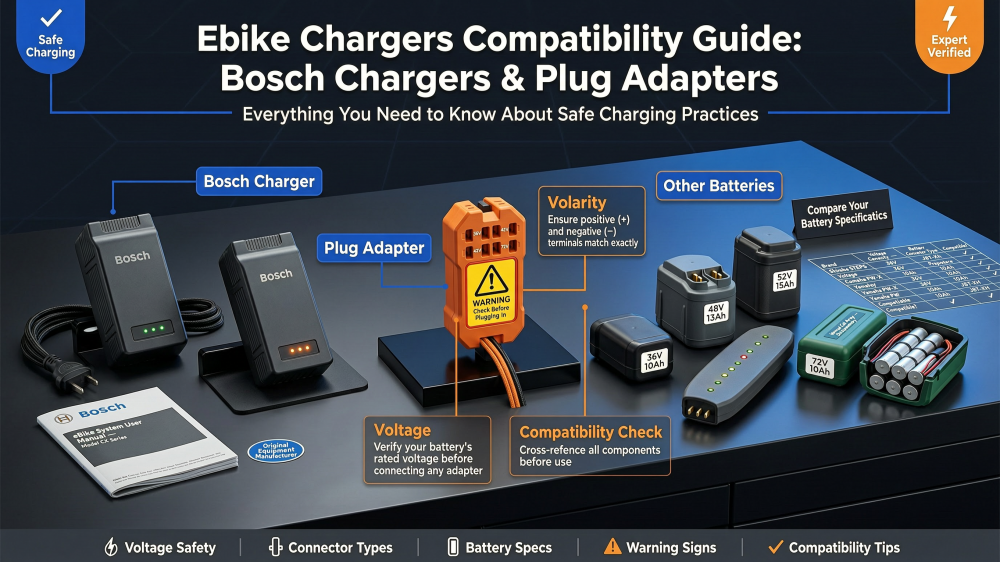
Introduction: Why Ebike Chargers Compatibility Matters
Ebike Chargers are one of the most important parts of an electric bike system, but they are also one of the most commonly misunderstood accessories. Many riders assume that if a charger fits the charging port, it must be safe to use. Others believe that a premium-brand charger, such as a Bosch e-bike charger, should work with many other batteries because it is well made. Unfortunately, charger compatibility is not that simple.
Using the wrong charger can cause more than a failed charging session. It can damage the battery management system, shorten battery life, overheat the battery, create electrical faults, or increase safety risks. This is especially important when dealing with lithium-ion e-bike batteries, which must be charged with the correct voltage, current, connector design, polarity, communication method, and charging profile.

Two common questions riders search for are: “Is a Bosch ebike charger compatible with other batteries?” and “Can I use an adapter to connect a charger with a different plug type?” These questions often come from real-world situations. A rider may lose the original charger, buy a used e-bike without a charger, travel with multiple e-bikes, or own a charger that has the correct voltage but the wrong plug. The temptation to use an adapter or borrow another charger can be strong.
This guide explains how Bosch-style charging systems differ from common universal e-bike chargers, why proprietary battery systems often require dedicated chargers, when a plug adapter may or may not be appropriate, and how to evaluate Ebike Chargers safely before connecting them to any battery. The goal is to help riders make safer decisions, avoid costly battery damage, and choose a charger that matches their exact e-bike battery system.
If you are replacing a lost charger, upgrading to a faster charger, buying a spare charger, or helping customers choose the right charger for Bosch, Super73, 36V, 48V, or other lithium e-bike systems, this article provides a practical compatibility framework you can use.
Quick Answer: Bosch Ebike Chargers and Adapter Compatibility
Before going into the details, here is the short answer for riders who need a fast safety summary.
| Question | Short Answer | Main Reason | Safety Recommendation |
|---|---|---|---|
| Is a Bosch ebike charger compatible with other batteries? | Usually no, unless the battery system is specifically designed to work with that Bosch charger. | Bosch systems often use proprietary connectors, voltage requirements, and system communication. | Use a Bosch-compatible charger only with batteries designed for that system. |
| Can I use a Bosch charger on a generic 36V, 48V, or 52V battery? | Not recommended. | Even if voltage appears close, plug wiring, charging logic, and BMS compatibility may differ. | Use the charger specified for the exact battery. |
| Can I use an adapter to connect a charger with a different plug type? | Only if voltage, current, polarity, chemistry, and wiring are fully compatible. | A plug adapter changes the physical connector, not the electrical charging requirements. | Verify every specification before using any adapter. |
| Does a matching plug mean the charger is safe? | No. | Many chargers share similar plugs but have different output voltages or polarity. | Always read the charger label and battery label. |
| What is the safest option? | Use a charger made for the battery’s voltage, chemistry, current rating, and connector type. | Correct specification matching protects the battery and BMS. | Choose a clearly labeled, safety-protected charger. |
The most important rule is simple: never judge Ebike Chargers by plug shape alone. A charger must match the battery electrically, mechanically, and sometimes digitally. This is especially true for branded systems such as Bosch, where the battery, charger, controller, display, and BMS may be part of an integrated ecosystem.
How Ebike Chargers Work with E-Bike Batteries
To understand why Bosch charger compatibility and plug adapters can be risky, it helps to understand what an e-bike charger actually does. An e-bike charger is not just a cable that sends power into the battery. It is a regulated power supply designed to charge a specific battery chemistry and voltage range.
Most e-bike batteries use lithium-ion cells. These cells require a controlled charging process, usually based on a constant-current and constant-voltage charging method. During the first stage, the charger supplies a controlled current while the battery voltage rises. During the second stage, the charger holds the voltage at a target level while the current gradually drops. When current falls low enough, the charger stops or switches to a full-charge state.
If the target voltage is too high, the battery may be overcharged. If the target voltage is too low, the battery may not fully charge. If the charging current is too high, the battery may overheat or experience unnecessary stress. If the connector polarity is wrong, electrical components may be damaged immediately. If the charger and battery require communication but cannot communicate properly, charging may fail or become unsafe.
Why Ebike Chargers Are Not All Interchangeable
E-bike chargers vary in several critical ways:
- Output voltage: The final charging voltage, such as 42V, 54.6V, or 58.8V.
- Output current: The charging speed, commonly 2A, 3A, 4A, or 5A.
- Battery chemistry: Lithium-ion, LiFePO4, lead-acid, and other chemistries require different profiles.
- Connector type: Barrel plug, 3-pin connector, XLR, aviation plug, magnetic connector, or proprietary plug.
- Polarity: Positive and negative wiring must match the battery port.
- Communication: Some branded systems may require electronic communication between battery and charger.
- Safety certifications: Quality chargers often include overload, overvoltage, short-circuit, and temperature protection.
This is why replacing a charger requires more than finding a plug that physically fits. For example, a 48V lithium battery commonly needs a 54.6V charger, while a 36V lithium battery commonly needs a 42V charger. A plug adapter cannot turn a 54.6V charger into a 42V charger. It only changes the plug interface.
Is a Bosch ebike charger compatible with other batteries?
In most cases, a Bosch ebike charger is not compatible with other batteries unless those batteries are specifically designed to work with the same Bosch e-bike system. Bosch e-bike charging systems are generally built as part of an integrated ecosystem. The charger, battery, motor drive unit, display, and battery management system are designed to operate together. This makes the system reliable and user-friendly when used correctly, but it also means Bosch chargers are usually not universal chargers for random e-bike batteries.
A Bosch charger may have a proprietary connector, specific voltage output, and compatibility requirements that are not shared by generic e-bike battery packs. Even if another battery has a similar voltage label, such as 36V, that does not automatically mean the charger is safe or compatible. The charger output voltage, connector wiring, communication logic, and battery management system requirements must all match.
Featured Snippet Answer: Is a Bosch ebike charger compatible with other batteries?
A Bosch ebike charger is generally not compatible with other batteries unless the battery is specifically designed for the same Bosch charging system. Bosch chargers may use proprietary plugs, system communication, and specific charging requirements. Using a Bosch charger on a non-compatible battery can fail to charge the battery or may damage the battery, BMS, or charger.
Why Bosch Chargers Are Often System-Specific
Bosch is known for integrated e-bike drive systems. Many Bosch-powered e-bikes use Bosch batteries and Bosch chargers designed to work together. This is different from some generic e-bike systems where the charger may simply provide a fixed output voltage and current through a standard connector. In a branded system, compatibility may depend on both electrical and system-level design.
The following factors can make a Bosch charger system-specific:
- Proprietary connector shape: The plug may be designed to fit only Bosch charging ports or Bosch-compatible charging sockets.
- Specific pin arrangement: Multiple-pin connectors may include more than basic positive and negative charging pins.
- Charging communication: Some systems may check charger and battery compatibility before allowing charge.
- Battery management integration: The BMS may expect a specific charging behavior.
- Voltage and current control: The charger may be designed for a particular Bosch battery family.
- Safety design: The charger may be built to operate within Bosch’s own system requirements.
Can a Bosch Charger Work on a Generic E-Bike Battery If the Voltage Is Similar?
Voltage similarity is not enough. For example, a battery may be labeled 36V, but different brands may use different connector designs, BMS limits, charge current limits, and charging logic. Even if two batteries have a similar nominal voltage, their required charging voltage and connector wiring may not be the same. A charger that works perfectly on a Bosch battery may not start charging a generic battery, or it may create an unsafe mismatch if connected through an improvised adapter.
If a rider wants to charge a generic e-bike battery, the safer choice is to use a charger designed for that battery’s actual specifications. For many common lithium systems, that may mean a 42V charger for a 36V battery, a 54.6V charger for a 48V battery, or a 58.8V charger for a 52V battery. The connector and polarity must also match.
Can a Generic Charger Work on a Bosch Battery?
This is also usually not recommended unless the charger is specifically designed and verified as Bosch-compatible. A generic charger with the same general voltage is not necessarily appropriate for a Bosch battery. The Bosch battery may require a specific plug, pin arrangement, charging behavior, or communication process. Using an unverified charger can cause charging failure, error codes, BMS lockout, warranty problems, or safety risks.
If a Bosch-compatible replacement charger is needed, choose a charger clearly designed for Bosch e-bike battery systems and verify the exact voltage, connector style, current rating, and model compatibility. A product page should clearly describe which battery types it supports so customers do not buy the wrong charger.
What Happens If You Use a Bosch Charger on the Wrong Battery?
Several outcomes are possible:
- Nothing happens: The charger may not detect the battery or may refuse to start charging.
- Error behavior: The battery or charger may show a fault state or flashing light.
- Partial or unstable charging: The charger may start but not charge correctly.
- Overheating: Mismatch can cause abnormal heat in the charger, adapter, or battery port.
- BMS damage: Incorrect voltage or wiring may damage the battery protection circuit.
- Charger damage: Reverse polarity or incorrect connection can damage the charger output stage.
- Safety hazard: Severe mismatch can increase the risk of electrical failure or fire.
The safest answer is to treat Bosch chargers as dedicated chargers unless compatibility is clearly confirmed by the charger manufacturer or battery manufacturer.
Key Factors That Decide Bosch E-Bike Charger Compatibility
When evaluating Bosch-style chargers or any branded e-bike charger, consider several layers of compatibility. A charger must match the battery in more than one way.
1. Voltage Compatibility
Voltage is the first requirement. The charger output must match the battery’s required charging voltage. For lithium-ion batteries, the charger output is usually higher than the battery’s nominal voltage. For example, many 36V lithium batteries charge to 42V, many 48V batteries charge to 54.6V, and many 52V batteries charge to 58.8V. A charger with the wrong voltage should not be used.
2. Current Compatibility
Current determines charging speed. A 2A charger charges more slowly than a 4A charger. A battery must be designed to accept the charger’s current. Using a current that is too high can increase heat and stress. When in doubt, use the current rating recommended by the battery manufacturer.
3. Connector Compatibility
The connector must physically fit and must be wired correctly. Bosch-style systems may use connectors that are not the same as standard barrel plugs or generic 3-pin connectors. Even if an adapter can be found, that does not guarantee the charger is compatible.
4. Polarity Compatibility
Polarity means the positive and negative connections must be correct. Some connectors look identical but have different wiring. Incorrect polarity can damage the charger, battery BMS, or charging port. Always check polarity before using an adapter.
5. Battery Chemistry Compatibility
Lithium-ion, LiFePO4, and lead-acid batteries require different charging profiles and voltage limits. A charger made for one chemistry should not be used on another unless it is explicitly designed for that chemistry.
6. Communication Compatibility
Some e-bike systems are not simple two-wire charging systems. They may include communication or identification pins. If a battery expects charger communication and the charger does not provide it, charging may not work. If a charger expects a certain battery response and does not receive it, it may shut down or show an error.
7. Thermal and Safety Protection
High-quality Ebike Chargers include protections such as overvoltage protection, overcurrent protection, short-circuit protection, automatic shutoff, and temperature control. These features do not make an incompatible charger safe, but they help reduce risk when the charger is correctly matched.
Can I use an adapter to connect a charger with a different plug type?
You can use an adapter to connect a charger with a different plug type only if the charger and battery are fully compatible in voltage, current, chemistry, polarity, and wiring. A plug adapter only changes the physical connector. It does not change the charger’s output voltage, charging current, battery chemistry profile, or communication requirements.
This is one of the most important safety points for e-bike owners. Many riders see plug adapters as a quick solution when the charger does not fit the battery port. In some cases, a properly designed adapter can be useful. For example, if the charger output is correct and only the connector type differs, a high-quality adapter with correct polarity and wiring may work. But if the charger voltage is wrong, an adapter can make a dangerous mismatch easier to connect.
Featured Snippet Answer: Can I use an adapter to connect a charger with a different plug type?
Yes, but only when the charger’s voltage, current, battery chemistry, polarity, and wiring match the battery requirements. A plug adapter changes only the connector shape; it does not make an incompatible charger safe. Never use an adapter just because the charger plug does not fit.
When a Charger Adapter May Be Acceptable
A charger adapter may be acceptable when all of the following conditions are true:
- The charger output voltage matches the battery’s required charging voltage.
- The charger current is within the battery’s allowed charging range.
- The charger is made for the same battery chemistry.
- The adapter wiring matches the battery port wiring.
- The polarity is confirmed correct.
- The connector is rated for the required current.
- The adapter fits securely without forcing or looseness.
- The battery does not require proprietary charger communication that the charger lacks.
For example, if a 48V lithium battery requires 54.6V charging and the charger outputs 54.6V at an acceptable current, but the battery uses a different connector, a properly wired and rated adapter may be possible. However, this should be verified carefully, especially if the battery is expensive or uses a branded system.
When You Should Not Use a Charger Adapter
You should not use a charger adapter in the following situations:
- You are not sure about the charger output voltage.
- The charger voltage does not match the battery charging voltage.
- The charger is for a different battery chemistry.
- The charger current exceeds the battery’s maximum charge current.
- The polarity is unknown.
- The adapter wiring is not documented.
- The battery or charger uses proprietary communication pins.
- The connector becomes hot, loose, or sparks when connected.
- The charger or battery shows error lights, unusual smells, or abnormal heat.
If you are unsure, do not connect the charger. It is better to buy the correct charger than to risk damaging an e-bike battery that may cost hundreds of dollars to replace.
Why Adapters Can Be Risky with Bosch Systems
Adapters are especially risky with Bosch-style charging systems because the connector may involve more than simple positive and negative charging lines. There may be additional pins or system logic involved. A homemade or generic adapter may not correctly support the charging process. Even worse, incorrect wiring could damage the charger or battery.
If you need a Bosch-compatible charging solution, use a charger specifically designed for Bosch-compatible batteries rather than forcing a generic charger through an adapter. A properly designed charger is safer and more reliable than an improvised connector workaround.
Ebike Chargers Adapter Risk Comparison Table
The table below shows common adapter use cases and whether they are generally safe, risky, or not recommended.
| Adapter Situation | Example | Risk Level | Recommendation |
|---|---|---|---|
| Correct voltage, correct current, same chemistry, confirmed polarity, simple connector change | 54.6V 2A charger to 48V lithium battery with verified adapter | Lower risk | May be acceptable if wiring and connector rating are confirmed |
| Correct voltage but unknown polarity | Adapter fits, but positive and negative pins are not confirmed | High risk | Do not use until polarity is verified |
| Wrong voltage but plug adapter makes it fit | 54.6V charger connected to a 36V battery using an adapter | Dangerous | Never use |
| Different battery chemistry | Lithium charger used on lead-acid or LiFePO4 battery | High risk | Use chemistry-specific charger |
| Higher current than battery supports | 5A charger used on battery rated for 2A maximum | High risk | Use current within manufacturer limit |
| Proprietary branded system | Generic charger adapted to Bosch-style battery port | High risk | Use verified Bosch-compatible charger only |
| Loose or poor-quality adapter | Adapter wiggles, sparks, or becomes hot | Dangerous | Stop using immediately |
The safest adapter use case is a simple connector conversion where all electrical specifications are already correct and confirmed. The most dangerous adapter use case is using an adapter to force an incompatible charger into a battery port.
Battery Voltage, Charger Output, and Connector Compatibility Table
The following table helps riders understand why charger labels matter more than plug appearance. These are common lithium-ion e-bike examples, but users should always confirm the exact battery label and user manual.
| Battery Type | Typical Full-Charge Voltage | Common Charger Output | Common Current Options | Adapter Use? |
|---|---|---|---|---|
| 36V lithium e-bike battery | 42V | 42V charger | 2A, 3A | Only if voltage, polarity, and plug wiring match |
| 48V lithium e-bike battery | 54.6V | 54.6V charger | 2A, 3A, 5A depending on battery | Possible only with correct specs and verified wiring |
| 52V lithium e-bike battery | 58.8V | 58.8V charger | 2A, 3A, 5A depending on battery | Possible only with correct specs and verified wiring |
| Bosch-style e-bike battery | Depends on Bosch battery family | Bosch-compatible charger required | Depends on charger model | Not recommended unless specifically designed and verified |
| Super73-style 48V lithium e-bike battery | 54.6V | 54.6V compatible charger | 2A or 3A commonly used | May be possible with correct plug and verified specs |
This table also shows why product pages should include actual charger output voltage. A title such as “48V charger” is useful, but a title such as “54.6V 2A E-Bike Charger for 48V Lithium Batteries” is much clearer and safer for customers.
Why Plug Fit Does Not Mean Charger Compatibility
One of the most dangerous misunderstandings about Ebike Chargers is the idea that a charger is compatible if the plug fits. In reality, connector fit is only one part of compatibility. Many chargers use similar-looking plugs, but the internal electrical specifications may be completely different.
For example, two chargers may both use a round barrel connector. One may output 42V for a 36V battery, while another may output 54.6V for a 48V battery. If the 54.6V charger is connected to a 36V battery, the battery may be exposed to serious overvoltage. The plug shape did not protect the battery.
Plug Shape Does Not Tell You Voltage
A barrel plug, 3-pin connector, or aviation plug does not automatically indicate voltage. The same connector family can be used for different battery systems. Always read the charger label and battery label.
Plug Shape Does Not Tell You Polarity
Two connectors can look the same but have opposite polarity. Connecting the wrong polarity can damage electronic components immediately. Polarity should be confirmed with documentation or proper testing by a qualified person.
Plug Shape Does Not Tell You Communication Requirements
Some connectors include extra pins for temperature sensing, charger detection, or communication. An adapter that only connects positive and negative lines may not support the full system. This is one reason proprietary systems should not be treated like generic two-wire batteries.
Plug Shape Does Not Tell You Charging Current
A connector may physically fit but may not be rated for the charger’s current. Poor adapters or undersized wiring can heat up during charging. Heat at the connector is a warning sign and should not be ignored.
Bosch-Style Chargers vs Universal Ebike Chargers
There is an important difference between Bosch-style chargers and universal or multi-plug e-bike chargers. Both can be useful when properly selected, but they are designed for different situations.
Bosch-Style Chargers
Bosch-style chargers are intended for specific Bosch-compatible battery systems. Their main advantage is system integration. When used with the correct battery, they can provide reliable and predictable charging. The disadvantage is limited compatibility. A Bosch charger should not be assumed to work with generic e-bike batteries.
Universal or Multi-Plug Ebike Chargers
Universal chargers often include multiple plug adapters, such as a 7-in-1 plug kit. This can be convenient for riders who need a charger that works with several connector styles. However, “universal” usually refers to plug compatibility, not unlimited voltage compatibility. A 54.6V 7-in-1 charger is still a charger for 48V lithium batteries, not for 36V or 52V batteries unless specifically designed with selectable voltage modes.
Smart Ebike Chargers
Some smart chargers offer features such as LED displays, voltage and current monitoring, multiple charging modes, temperature protection, and storage charging. These features can improve convenience and battery care, but the charger must still match the battery’s required voltage and chemistry. Smart features do not replace basic compatibility.
Which Type Should You Choose?
If you have a Bosch e-bike battery, choose a charger specifically designed for that Bosch-compatible system. If you have a common 48V lithium e-bike battery, choose a 54.6V charger with the correct current and plug. If you need broad connector support, a multi-plug charger may be useful, but only if the voltage and current match your battery.
How to Check Before Using a Charger Adapter
Before using any adapter with Ebike Chargers, follow a careful verification process. This checklist is useful for riders, repair shops, and online store customers.
Step 1: Identify the Battery Voltage
Find the battery label or manual. Look for nominal voltage and charging voltage. Do not guess based on bike appearance. A fat tire e-bike, commuter bike, or scooter-style e-bike may use 36V, 48V, 52V, or another voltage system.
Step 2: Identify the Charger Output Voltage
Read the charger label. Look for “Output” followed by voltage and current. Examples include 42V 2A, 54.6V 3A, or 58.8V 2A. The charger output voltage must match the battery charging voltage.
Step 3: Confirm Battery Chemistry
Make sure the charger is designed for the same battery chemistry. A lithium-ion charger should not be used on a different chemistry unless the charger manufacturer clearly states compatibility.
Step 4: Confirm Current Rating
Check whether the battery can accept the charger’s current. If the battery supports 2A charging, do not use a 5A charger unless the manufacturer confirms it is safe. Faster charging is not always better.
Step 5: Confirm Connector Wiring
Do not assume an adapter is wired correctly. Check pinout diagrams or manufacturer information. For multi-pin connectors, identify which pins are positive, negative, and communication or sensing lines.
Step 6: Confirm Polarity
Polarity must match. Incorrect polarity can damage electronics. If you are not qualified to verify polarity, ask a professional technician or use a charger designed for your battery.
Step 7: Inspect the Adapter Quality
A safe adapter should have secure connectors, adequate wire gauge, proper insulation, and a current rating suitable for charging. Avoid loose, thin, damaged, or unbranded adapters with unclear wiring.
Step 8: Monitor the First Charging Session
If all specifications are confirmed and you use an adapter, monitor the first charging session carefully. Watch for heat, smell, unusual charger behavior, sparks, error lights, or battery swelling. If anything seems abnormal, unplug immediately.
Safe Charging Best Practices for Bosch and Other E-Bike Batteries
Whether you use Bosch-compatible chargers, Super73-compatible chargers, or general lithium Ebike Chargers, safe charging habits can protect your equipment and reduce risk.
Use the Correct Charger
The safest charger is the one designed for your exact battery voltage, chemistry, connector, polarity, and current requirement. Do not use a charger simply because it is available.
Do Not Force a Plug
If the plug does not fit naturally, do not force it. Forcing a connector can bend pins, damage the port, or create poor contact. A loose or damaged charging port can heat up during charging.
Avoid Cheap Unknown Adapters
Low-quality adapters may use thin wiring, poor solder joints, weak insulation, or incorrect pinouts. A charger adapter carries charging current into the battery, so quality matters.
Charge in a Safe Location
Charge on a stable surface in a dry, ventilated area away from flammable materials. Avoid charging under bedding, inside bags, in direct sunlight, or near heat sources.
Do Not Charge a Damaged Battery
If the battery has been dropped, crashed, submerged, swollen, leaking, or smells unusual, do not charge it. Have it inspected by a qualified technician.
Unplug After Charging
Many quality chargers stop automatically, but unplugging after charging is still a good habit. This reduces unnecessary standby time and keeps the charging area safer.
Label Your Chargers
If you own multiple e-bikes, label each charger with the bike or battery it belongs to. This simple habit prevents accidental mismatches, especially between 36V, 48V, and 52V systems.
Replace a Charger That Gets Abnormally Hot
Chargers may become warm during normal operation, but excessive heat is a warning sign. If the charger case becomes too hot to touch, smells like burning plastic, makes unusual noises, or causes the plug to heat up, stop using it.
Readable Product Title Examples for Ebike Chargers
For SEO and conversion, charger product titles should be easy to understand. Customers searching for Ebike Chargers often want to know immediately whether the product matches their battery. A readable title reduces confusion and improves purchase confidence.
| Unclear Product Title | Better SEO Product Title | Why It Is Better |
|---|---|---|
| Bosch Charger | 42V 2A Bosch-Compatible E-Bike Charger for Select Bosch Battery Systems | Includes voltage, current, and compatibility context. |
| Fast Bike Charger | 54.6V 3A Fast E-Bike Charger for 48V Lithium Battery Packs | Explains output voltage and battery type clearly. |
| Universal Charger | 54.6V 2A E-Bike Charger with 7-in-1 Plugs for 48V Lithium Batteries | Clarifies that the plugs are universal, not the voltage. |
| 52V Charger | 58.8V 2A E-Bike Charger for 52V Lithium Battery Packs | Uses the correct full-charge voltage for 52V batteries. |
| Replacement Charger | 42V 4A Replacement Charger for Bosch-Compatible E-Bike Batteries | Targets replacement searches while keeping specifications visible. |
Product titles should avoid misleading claims such as “fits all e-bikes” unless the charger truly supports multiple voltages, chemistries, connectors, and safety profiles. A better approach is to describe the exact output and compatible battery type.
FAQ About Bosch Ebike Chargers, Other Batteries, and Plug Adapters
Is a Bosch ebike charger compatible with other batteries?
Usually no. A Bosch ebike charger is generally designed for Bosch-compatible battery systems. It should not be used on other batteries unless compatibility is specifically confirmed.
Can I use a Bosch charger on a generic e-bike battery?
It is not recommended. Even if the voltage seems similar, the connector wiring, polarity, charging behavior, and BMS requirements may not match.
Can I use a generic charger on a Bosch battery?
Only if the charger is specifically designed and verified as Bosch-compatible. A generic charger with a similar voltage is not automatically safe for a Bosch battery.
Can I use an adapter to connect a charger with a different plug type?
Yes, but only if the charger voltage, current, chemistry, polarity, and wiring all match the battery requirements. A plug adapter does not change the charger’s electrical output.
Does a plug adapter make any charger universal?
No. An adapter only changes the connector shape. It does not change voltage, current, polarity, battery chemistry, or communication requirements.
What is the biggest danger of using the wrong charger adapter?
The biggest danger is connecting a charger with the wrong voltage or polarity to the battery. This can damage the battery, BMS, charger, or charging port and may create a safety hazard.
Why do some Bosch batteries not charge with generic chargers?
Some branded battery systems may require specific connector design, pin arrangement, charging behavior, or system communication. A generic charger may not meet these requirements.
Can I use a 54.6V charger with an adapter on a 36V battery?
No. A 54.6V charger is commonly used for 48V lithium batteries. A 36V lithium battery usually needs a 42V charger. Using an adapter would not make the voltage safe.
Can I use a 42V charger on a Bosch battery?
Only if the Bosch-compatible battery system specifically requires that charger output and connector design. Do not assume compatibility based on voltage alone.
How do I know if my e-bike charger adapter is wired correctly?
You need verified pinout information from the charger, adapter, and battery port. If you cannot confirm polarity and wiring, do not use the adapter.
Is a multi-plug e-bike charger safe?
A multi-plug charger can be safe if the voltage, current, chemistry, polarity, and selected plug match the battery. Multi-plug does not mean multi-voltage unless clearly stated by the charger design.
Can the BMS protect my battery from a wrong charger?
A BMS may provide protection against some faults, but it should not be used as an excuse to connect an incompatible charger. The correct charger is still required.
What should I do if I used the wrong charger?
Unplug it immediately. Check for heat, swelling, smell, sparks, error lights, or abnormal behavior. Do not continue charging. If anything seems wrong, contact a qualified technician or the battery supplier.
What charger should I buy if I lost my original charger?
Read the battery label and identify the required charging voltage, current, chemistry, connector, and polarity. Then buy a charger designed for those exact specifications.
Are Ebike Chargers with 7-in-1 plugs better?
They can be convenient because they support multiple connector types. However, you still must choose the correct voltage and current for your battery. A 7-in-1 plug kit does not make one charger suitable for every e-bike battery.
Conclusion: Choose Ebike Chargers by Specification, Not by Guessing
When it comes to Ebike Chargers, compatibility should never be guessed. A Bosch ebike charger is generally not compatible with other batteries unless those batteries are specifically designed to work with the same Bosch-compatible charging system. Bosch-style chargers may use proprietary plugs, unique pin layouts, specific charging behavior, and battery management integration that generic batteries do not support.
Using an adapter to connect a charger with a different plug type can also be risky. An adapter only changes the physical plug. It does not change voltage, current, chemistry, polarity, or communication requirements. If the charger is electrically incompatible, an adapter can make a dangerous connection possible.
The safest approach is to match the charger to the battery’s real specifications. Confirm the battery’s required charging voltage, charger output voltage, charging current, battery chemistry, connector type, polarity, and any proprietary communication requirements. For common lithium e-bike systems, this may mean a 42V charger for a 36V battery, a 54.6V charger for a 48V battery, or a 58.8V charger for a 52V battery. For Bosch-compatible systems, use a charger specifically designed for the correct Bosch battery family.
A reliable charger protects your battery, supports consistent range, reduces charging stress, and helps riders avoid expensive mistakes. Whether you are buying a replacement charger, choosing a multi-plug charger, or evaluating a Bosch-compatible charging solution, remember this rule: the right charger is the one that matches the battery specifications, not just the charging port.
Share:
Can I Use a 48V Charger on 36V or 52V E-Bike Batteries? Ebike Chargers Safety Guide