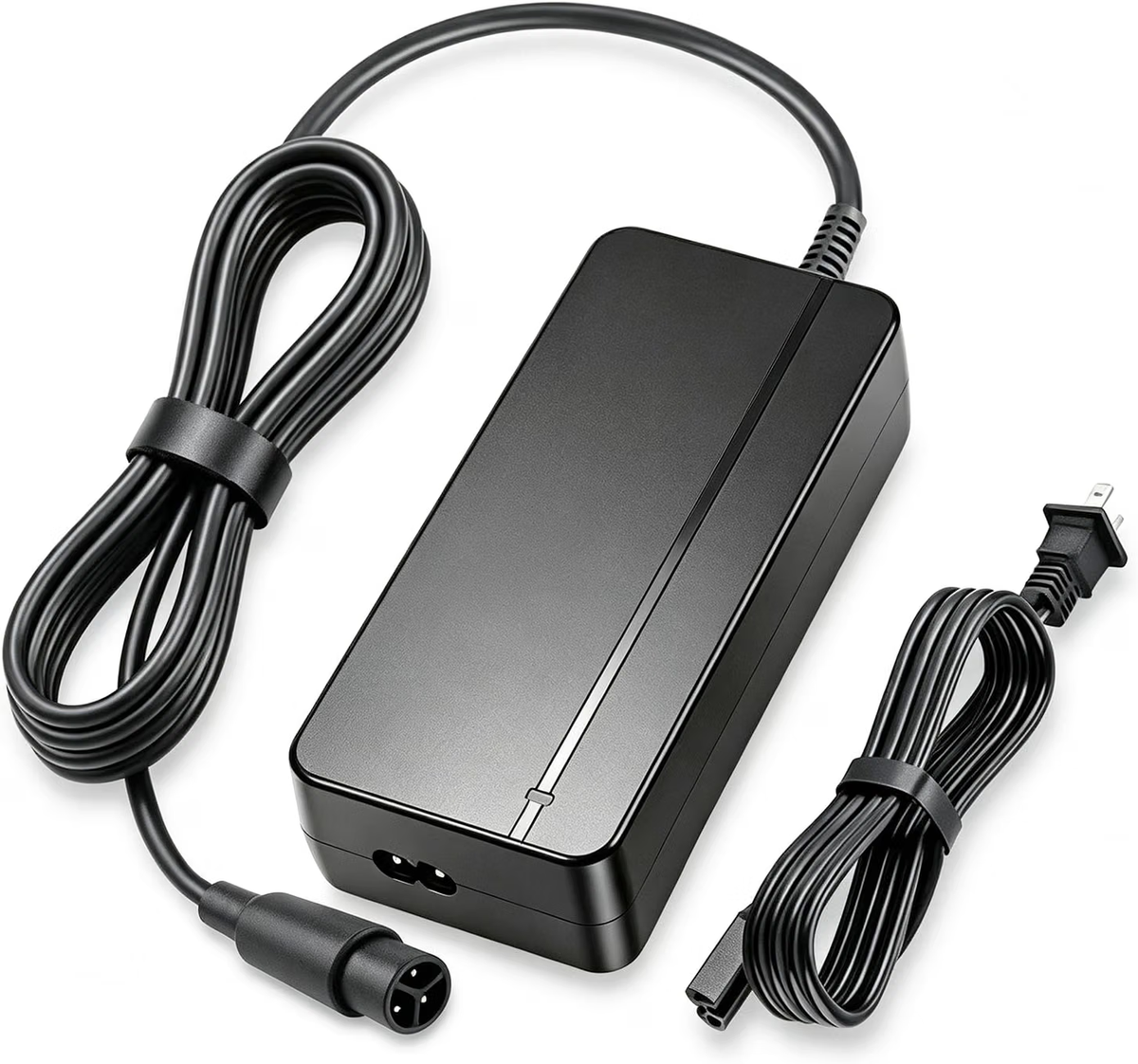
Quick answer: A replacement charger for a compatible Lectric 48V lithium-ion e-bike must match more than the bike name. Before ordering, compare the battery chemistry, the original charger’s DC output voltage, the charging connector, polarity, and the maximum charging current supported by the battery and bike. For a compatible 48V lithium-ion system, the replacement charger may be labeled 54.6V DC output—but that voltage alone does not prove compatibility.

Why a 48V battery may use a 54.6V charger
“48V” usually describes the battery system’s nominal voltage, not the charger’s final DC output. A common 48V lithium-ion pack uses 13 cell groups in series, and a conventional full-charge target is approximately 54.6V. That is why a charger can be marketed for a 48V lithium battery while its output label reads 54.6V.
This relationship is useful, but it is not permission to use any 54.6V charger. Different battery designs, connectors, polarity arrangements, battery-management systems, and manufacturer requirements can make two chargers incompatible even when the printed voltage is the same.
Five checks before buying a Lectric replacement charger
1. Confirm the exact bike model and version
Model families can change between production years. A charger listing may mention Lectric XP4, XPedition 2.0, XPeak 2.0, or XP Trike2, but the model name should be treated as a starting point—not the only compatibility test. Check the label on the battery and the original charger whenever possible.
2. Confirm lithium-ion battery chemistry
The BICMDO product discussed here is intended for compatible 48V lithium-ion batteries. Do not use it with lead-acid, nickel-based, LiFePO4, or another chemistry unless the battery manufacturer explicitly approves the exact charger profile. Battery chemistry changes the required charging behavior.
3. Match the DC output voltage
Look for the “OUTPUT” line on the original charger. For the compatible system covered here, it should show 54.6V DC. Do not confuse this with the “INPUT” line, which may show a wide AC range such as 100–240V.
4. Compare connector shape, dimensions and polarity
A plug that looks close can still be wrong. Compare the number of pins, outer diameter, inner diameter, keying, locking features and polarity. Never force a connector. A reversed-polarity or incorrectly wired charger can damage the charging port, charger or battery.
5. Verify the permitted charging current
Charging current is shown in amps (A). The BICMDO Lectric XP4 charger page currently offers 2A, 3A and 5A variants, but the highest number is not automatically the best choice. The bike, battery-management system, charging port and wiring must all support the selected current.

2A vs 3A vs 5A: which charging current should you choose?
| Option | Typical reason to consider it | What to verify first |
|---|---|---|
| 2A | Conservative replacement when the original charger is 2A | 54.6V output, connector and polarity |
| 3A | Potentially shorter charging time than 2A | Written confirmation that the exact battery and port support 3A |
| 5A | Higher-current charging for specifically approved systems | Explicit support for 5A from the bike/battery documentation or manufacturer |
In idealized terms, higher current can reduce charging time, but real charging is not perfectly linear. The battery-management system may reduce current near full charge, and temperature or battery condition may also affect the process. Never upgrade from 2A to 3A or 5A based only on a desire to charge faster.
How to read the original charger label
Take a clear photo of the original charger label before shopping. Record these items:
- Input: the wall-power range accepted by the charger.
- Output voltage: for this compatible 48V lithium application, 54.6V DC.
- Output current: for example, 2A, 3A or 5A.
- Polarity symbol: identifies which conductor is positive and negative.
- Model or part number: useful when confirming compatibility with support.
- Safety marks and manufacturer information: compare them with the replacement product documentation.
If any part is unreadable, do not guess. Send photos of the battery label, charging port and original charger label to support for review.
Compatible models listed by BICMDO
The current BICMDO product page lists the charger for compatible versions of:
- Lectric XP4
- Lectric XPedition 2.0
- Lectric XPeak 2.0
- Lectric XP Trike2
Because specifications may vary by model year or production version, this list should not replace the five checks above. You can review current availability and variant options on the BICMDO Lectric XP4 charger product page.
Safe charging routine after the replacement arrives
- Inspect the charger, cable and connector for shipping damage.
- Charge in a dry, ventilated area away from flammable materials.
- Use a sound wall outlet; avoid damaged extension cords and overloaded power strips.
- Follow the connection order in the bike or charger instructions.
- Do not cover the charger while it is operating.
- Stop using it if you notice swelling, smoke, sparking, melting, a strong unusual odor or abnormal heat.
- Disconnect after charging according to the manufacturer’s instructions; do not leave a questionable setup unattended.
For more background on voltage terminology, read 54.6V vs 48V Charger: Which One Do You Need?. If you are troubleshooting unusual temperature, see Is It Normal for an E-Bike Charger to Get Hot?.
Common replacement-charger mistakes to avoid
- Shopping by bike name alone: production changes can affect the battery, port or charger even within one model family.
- Reading input instead of output: the wall-input range does not tell you the battery charging voltage.
- Assuming the highest amp option is an upgrade: faster charging is appropriate only when the complete system supports it.
- Using an adapter to solve an electrical mismatch: an adapter may change plug shape, but it does not correct voltage, current, polarity or battery chemistry.
- Ignoring cable condition: a charger with the right label should still be rejected if the housing, cable or connector is damaged.
A few minutes spent comparing labels can prevent an expensive battery or charging-port problem. Keep the original charger until the replacement has been fully checked, and photograph its label for future reference.
Frequently asked questions
Can I use any 54.6V charger on a Lectric 48V e-bike?
No. The voltage may match while the connector, polarity, current rating or manufacturer requirements do not. Verify every compatibility point before connection.
Is a 5A charger always better than a 2A charger?
No. A 5A charger should be used only when the exact battery, battery-management system, port and wiring are approved for that current. Otherwise, use the manufacturer-recommended rating.
Will a higher-current charger always cut charging time in half?
No. Charging time depends on battery capacity, starting charge level, current limits, temperature and the slower balancing phase near full charge.
What if the plug fits but the charger light behaves strangely?
Disconnect it and recheck the labels, connector and instructions. A fitting plug does not prove electrical compatibility. Do not repeatedly reconnect an uncertain charger.
What information should I send support?
Send clear photos of the bike model label, battery label, original charger label and charging port, plus the model year if known. This gives support more evidence than the bike name alone.
Bottom line
A safe replacement decision is a matching exercise: 48V lithium-ion battery, 54.6V charger output, correct connector, correct polarity and an approved charging current. Confirm all five before ordering. If your labels match the supported application, compare the available 2A, 3A and 5A options on the Lectric XP4 charger page. If anything differs or remains unclear, pause and ask the bike or battery manufacturer for confirmation.
Lectric is a trademark of its respective owner. BICMDO is not the bike manufacturer. Model names are used only to help identify potential charger applications; compatibility must be verified for the exact bike and battery.
Share:
Razor Scooter Charger Guide: How to Match MX350, MX400, E100, E200 and E300 Versions
Pride Go-Go Mobility Scooter Charger Guide: How to Match 29V, Lead-Acid and 3-Pin XLR