
2A vs 3A E-Bike Chargers: Charging Time, Compatibility and Safety
A 3A charger can deliver more current than a 2A charger, so it may shorten charging time. But more amps do not make a charger compatible. Before choosing either one, the battery chemistry, required charging voltage, connector, polarity and the device manufacturer's approved charging current all have to match. A plug that fits is not proof that the charger is safe for the battery.
That warning matters. The U.S. Consumer Product Safety Commission (CPSC) says chargers marketed as “universal” may physically fit a micromobility device while remaining electrically incompatible. Its guidance is to use the charger supplied with the device or a replacement tested and approved to work safely with that device.
Use this guide to understand the numbers and ask the right questions. If you cannot verify every required specification from the battery label, original charger, manual or manufacturer, do not connect the replacement.

The short answer: what changes from 2A to 3A?
“A” means amperes, a measure of charging current. If the battery and its battery-management system are designed to accept both options, a 3A charger supplies current faster than a 2A charger during much of the charging cycle. In idealized math, 3A is 50% more current than 2A. Real charging time will not improve by exactly 50%, however, because lithium-ion charging is not a constant-rate process from empty to full. The current typically tapers near the end, and temperature, battery condition, balancing and starting state of charge all affect the result.
The practical decision is therefore:
- Choose 2A when it matches the original specification or when the manufacturer approves 2A but not 3A.
- Choose 3A only when the battery, charge port, wiring and manufacturer documentation explicitly support it.
- Choose neither if voltage, chemistry, connector or polarity does not match.
Never select current by connector shape alone.
First match voltage and battery chemistry
Current is not the first compatibility question. Charging voltage and chemistry come before amps.
A common 48V nominal lithium-ion e-bike pack uses 13 cell groups in series and requires a charger with a 54.6V output. A common 52V nominal lithium-ion pack uses 14 series groups and commonly requires 58.8V. A 36V lithium-ion scooter battery commonly requires 42V. These relationships apply to the specified lithium-ion pack configurations; they are not interchangeable with lead-acid or lithium iron phosphate batteries.
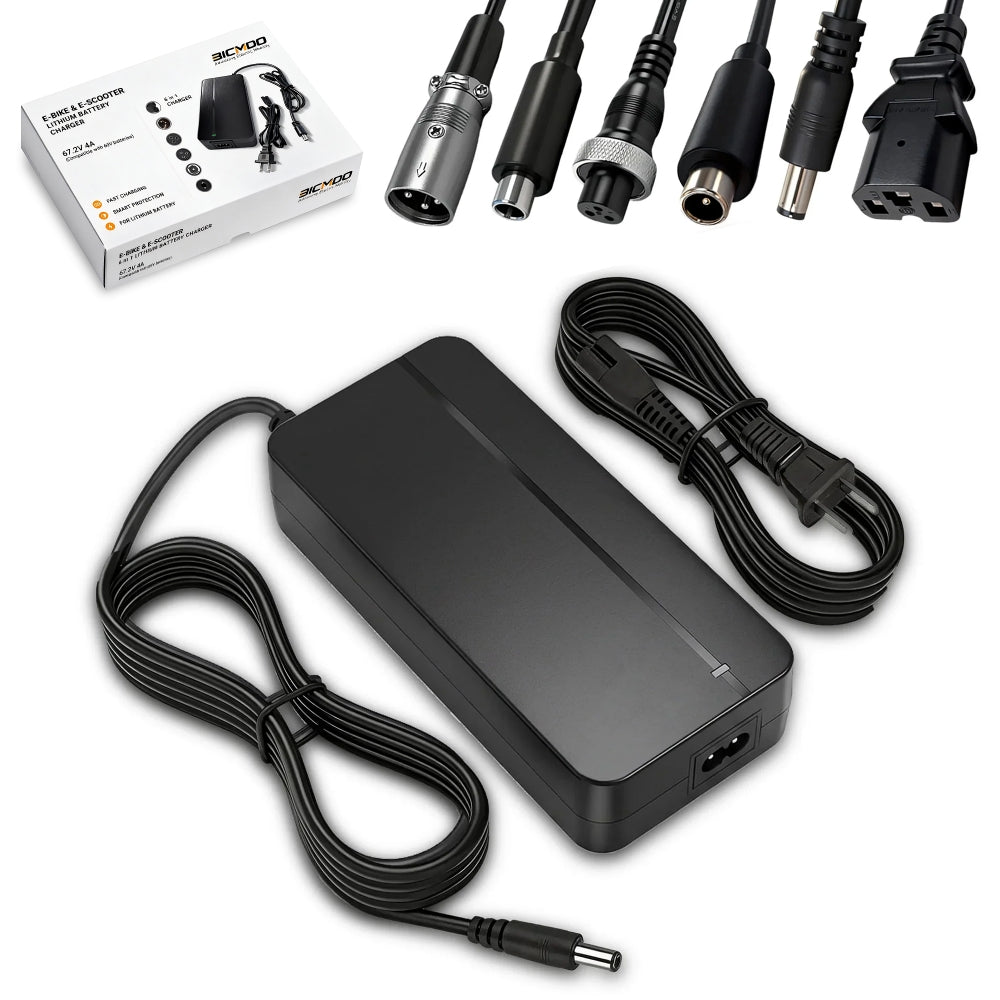
The BICMDO 54.6V 2A/3A charger, for example, is listed for compatible 48V lithium-ion systems and offers 2A and 3A variants. The BICMDO 58.8V charger is listed for compatible 52V lithium-ion systems. The difference is essential: a 58.8V charger is not a faster version of a 54.6V charger. It is intended for a different battery voltage.
If the original label is readable, compare:
- Battery chemistry
- Nominal battery voltage
- Original charger output voltage
- Original charger output current
- Connector type and dimensions
- Connector polarity or pin assignment
- Manufacturer approval and any maximum charge-current limit
Our broader charger matching guide explains all six electrical and physical checks.
Charging-time math: a useful estimate, not a promise
A simple starting estimate is:
Battery capacity in amp-hours ÷ charger current in amps = idealized hours
For a 14Ah battery:
- 14Ah ÷ 2A = 7 idealized hours
- 14Ah ÷ 3A = about 4.7 idealized hours
For a 20Ah battery:
- 20Ah ÷ 2A = 10 idealized hours
- 20Ah ÷ 3A = about 6.7 idealized hours
Those figures assume charging from fully empty at the labeled rate. Actual time can be longer because charging current tapers near full charge, the battery-management system may balance cells, and the charger has conversion losses. Most riders also begin charging with energy still remaining, so an ordinary top-up may be shorter.
A better estimate uses the amount you expect to replace. If a healthy 20Ah battery is approximately half discharged, the theoretical replacement is around 10Ah. That gives roughly five hours at 2A or 3.3 hours at 3A before allowing for tapering and losses. Treat this as planning math—not a guaranteed completion time or a battery-health test.
Is 3A automatically “fast charging”?
Not in a universal sense. “Fast” is relative to battery capacity and the original charging specification. For a large 20Ah pack, 3A is only 0.15C, where C-rate compares current with capacity. For a much smaller battery, the same current represents a larger C-rate. The battery manufacturer decides what the cells, battery-management system, charge connector and wiring can safely accept.
This is why copying another rider's setup is risky even when both bikes are marketed as 48V. Their batteries may have different cells, capacities, ports, wiring and maximum charge current.
A higher-current charger can also produce more heat in the charger, connector or battery if the system was not designed for it. If the plug, cable, port or battery becomes unusually hot, emits an odor, changes shape, makes unusual sounds or shows discoloration, stop charging, disconnect only if it is safe to do so, move away and follow emergency guidance. Do not continue testing a questionable pack indoors.

Why a 7-in-1 plug set is not universal compatibility
Interchangeable tips can solve the mechanical problem of reaching different port shapes. They do not solve electrical compatibility. A 7-in-1 charger still requires the correct output voltage, chemistry, current allowance and polarity for the exact device.
The CPSC specifically warns that a charger described as suitable for a general category—or even a brand—may still be incompatible with a particular device. Between January 2023 and May 16, 2024, the agency received 156 reports of fire and thermal incidents involving chargers marketed as universal. Its advice is direct: use the provided charger, or confirm that a replacement has been tested and approved to work safely with the device.
Before connecting an interchangeable tip:
- Compare the tip dimensions with the original connector.
- Confirm whether the connector is male or female at the device.
- Verify positive and negative polarity with reliable documentation; do not guess from appearance.
- For multi-pin connectors, verify the pin assignment. Two plugs can look alike but use different live pins.
- Confirm that the selected tip locks or seats fully without force or looseness.
Do not cut, splice or reverse leads unless the work is performed and validated by a qualified technician to the device manufacturer's requirements.
A safe replacement-charger checklist
1. Ask the original manufacturer first
Request the exact replacement part or written compatibility requirements. This is the strongest route when the original charger is missing. A retailer's compatibility list can help identify a candidate, but the device manufacturer or battery documentation should settle uncertain specifications.
2. Photograph every label
Take clear photos of the battery label, original charger label, charge port and connector. Include the entire bike or scooter model and serial/version information. Production years can change ports or charging requirements under the same model name.
3. Require an exact charging-voltage match
Do not confuse battery nominal voltage with charger output. “48V battery” and “48V output charger” are not normally equivalent descriptions for a 13S lithium-ion pack; the typical full-charge output is 54.6V. Read our 54.6V versus 48V charger explanation for the distinction.
4. Match chemistry exactly
A lithium-ion charger is not automatically suitable for lead-acid or LiFePO4 packs, even if a nominal voltage sounds similar. Charging profiles and termination voltages differ.
5. Confirm allowed current
Using 3A in place of 2A is acceptable only when the manufacturer approves that current for the battery and device. Otherwise, stay with the specified rate. Do not infer approval from battery capacity alone.
6. Verify connector and polarity
A connector must match mechanically and electrically. Compare markings and pin diagrams. If polarity is undocumented, contact the manufacturer or a competent service provider rather than experimenting.
7. Inspect before every charge
Do not use damaged cables, loose connectors, cracked housings, scorched pins or a swollen battery. Plug directly into an appropriate wall outlet where the manufacturer instructs; avoid overloaded extension arrangements. Place the charger on a hard, stable, noncombustible surface with ventilation openings unobstructed.
Safer charging habits after you choose the correct charger
The correct specifications reduce one major risk but do not make unattended charging wise. The CPSC recommends being present while charging, never charging while sleeping, and unplugging after the cycle completes rather than leaving the charger connected for long periods. Its micromobility safety center also advises following the manufacturer's instructions and using only the provided or recommended charger.
The FDNY notes that lithium-ion batteries store substantial energy and can overheat, catch fire or explode if defective or mistreated. Its resources advise consumers to use approved equipment and to stop using batteries showing warning signs.
A practical routine is:
- Let the battery cool after a demanding ride if the manufacturer requires it.
- Charge in a dry, ventilated area away from exits and combustible materials.
- Remain awake and nearby.
- Check occasionally for abnormal heat, smell, noise, smoke or swelling.
- Disconnect after completion according to the manual.
- Keep the charger, battery and port dry and clean.
For additional warning signs, read Is it normal for an e-bike charger to get hot? and Is it safe to charge an e-bike overnight?.

Frequently asked questions
Can I replace a 2A charger with a 3A charger?
Only if the output voltage, chemistry, connector and polarity match and the device or battery manufacturer confirms that 3A is an approved charging current. A matching plug and voltage alone are insufficient.
Will 3A damage a 48V 20Ah battery?
Capacity alone cannot answer that. The cell design, battery-management system, wiring, port and manufacturer's limit determine the permitted current. Consult the battery or device documentation.
Can I use a 58.8V charger on a 48V lithium-ion battery?
No. A 58.8V charger is commonly intended for a 14S, 52V nominal lithium-ion pack, not a common 13S, 48V nominal pack that requires 54.6V. The higher charging voltage can create a serious hazard.
Why does charging slow near full?
Lithium-ion charging commonly transitions from constant current to constant voltage as it approaches full charge, so current tapers. Cell balancing and temperature can add time. That is why capacity divided by current is only an idealized estimate.
Bottom line
A 3A charger may save time when the battery system was designed for it. A 2A charger may be the correct and safer choice when it matches the original specification. In either case, current is only one line of the compatibility checklist.
Start with the device manufacturer. Match chemistry and charging voltage exactly, verify the connector and polarity, confirm the allowed current, and use safer charging practices every time. If any specification remains uncertain, do not connect the charger.
Share:
52V E-Bike Charger Guide: How to Match 58.8V, Amps, Connector and Polarity